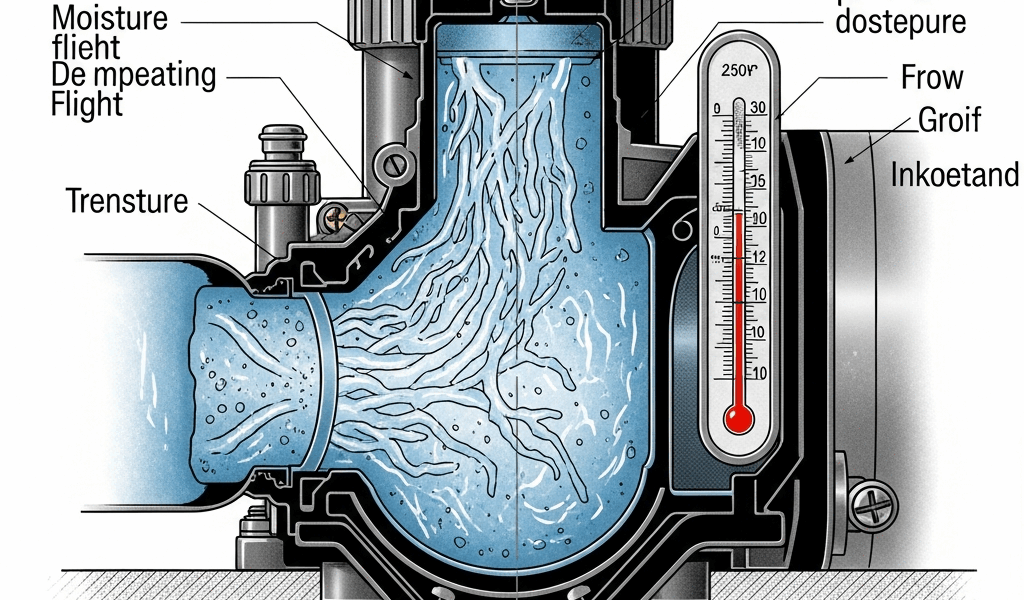
What Carb Ice Actually Does to Your Engine
Carburetor icing in the Cessna 172 has gotten complicated with all the conflicting advice flying around.
So, what is carb ice? In essence, it’s what happens when fuel vaporizing through the carburetor throat drops the local air temperature so dramatically that moisture freezes right inside the intake passage. But it’s much more than that. The venturi effect — the pressure drop as air accelerates through that narrow throat — amplifies the cooling well beyond what most pilots expect. We’re talking 40 to 70 degrees Fahrenheit of temperature drop inside the carb itself. Outside air could read a perfectly reasonable 55°F and you’d never suspect a thing.
The real danger zone sits between 20°F and 70°F OAT paired with high relative humidity. I’ve personally watched carb ice form on a clear July morning at 3,000 feet MSL when the dew point spread was sitting at maybe 4 degrees. Shirt sleeves weather. Not a cloud anywhere. The humidity, not the thermometer reading, is what drives ice crystal formation inside your fuel system.
When that ice restricts the main jet or chokes off fuel flow, the mixture leans out hard. Combustion gets rough. Incomplete. That’s when the stumble starts — quiet at first, then impossible to ignore.
How to Recognize It Before It Gets Bad
Symptoms show up in sequence. Memorize the sequence.
- Subtle RPM drop of 100–200 RPM in cruise — You’ve trimmed for level flight at 2,300 RPM. Nothing changes in the cockpit. Then the tachometer needle drifts — quietly, almost politely — down to around 2,100. No wind shear. No trim movement. Just disappearing power. Most pilots miss this entirely, especially early in the flight when they’re still getting settled.
- Rough idle during approach — The engine starts sounding like it’s running short a cylinder. Uneven combustion, vibration feeding back through the yoke. Magneto check comes back clean, so pilots blame flap extension or gear buffet and keep flying right into the pattern.
- Engine stumble at low power — Pulling power back during descent, the engine actually coughs. Sometimes it catches itself. Sometimes it doesn’t. This is the moment where carb heat should already be on — not where you’re first thinking about it.
The sound has a character to it. Nothing like a magneto miss, which hits sharp and repeats rhythmically. Carb ice sounds wet and labored — like the engine is working against something it can’t quite push through. Probably should have opened with that detail, honestly. Knowing the sound means you skip the misdiagnosis panic entirely. Don’t make my mistake of spending thirty seconds checking magnetos while the ice kept building.
The Right Way to Apply Carb Heat in a 172
While you won’t need any special tooling or avionics upgrade to manage carb ice, you will need a handful of solid habits and an understanding of what the system actually does. Pulling that carb heat knob reroutes intake air from around the engine — hot air, typically 100°F or better — bypassing the cold outside air inlet entirely. The heat melts the ice. But the process takes time, and things get worse before they improve.
Step one: Pull carb heat fully the moment you recognize the symptom. Not halfway. All the way. The 172’s carb heat control is binary — full on or full off. There is no middle setting that does anything useful.
Step two: Watch the tachometer drop another 50 to 150 RPM in the first 15 to 30 seconds. New pilots hate this part. The engine sounds rougher. RPM falls further. Every instinct says push the knob back in immediately. Resist that. Hot air runs less dense than cold air, so you’re momentarily burning a richer mixture through a carburetor that’s just starting to warm up. The power dip is normal. It passes.
Step three: Hold carb heat on for a minimum of 30 to 60 seconds — at least if you want the ice gone completely. Descending at 1,200 RPM on approach power? Sixty seconds, minimum. The ice doesn’t melt on your schedule.
Step four: If you’ve got a carburetor air temperature gauge installed — a Insight GEM or a basic Alcor CAT gauge works fine, usually around $80 to $150 fitted — watch for the needle to climb into the yellow arc, somewhere around 100 to 120°F carburetor inlet temperature. That’s your confirmation the heat is actually reaching the throat.
RPM recovers smoothly and the roughness clears? You caught it early. Leave carb heat on through the rest of the descent and the entire approach. Pull it off in the climb and during cruise where conditions don’t support icing. The risk peaks during low-power extended descents — I’m apparently someone who used to forget this every single time on long cross-countries, and a sticky note on the throttle quadrant worked for me while memory alone never did.
If RPM never comes back and the roughness hangs on past 90 seconds of full carb heat, the blockage has gone beyond the main jet. That changes the situation entirely.
Conditions That Catch Pilots Off Guard
Three specific scenarios trap experienced pilots. Each one works because it violates the mental model most 172 drivers carry about when carb ice is a real threat. So, without further ado, let’s dive in.
Scenario one: Clear summer days with high dew points. Outside air temperature reads 68°F. Visibility is 15 miles. The sky is postcard blue. But relative humidity is running 85% because the dew point is sitting at 62°F — a spread of only 6 degrees. Carb ice builds aggressively in those conditions. NTSB accident clustering shows June and July events, not January ones, because pilots are flying relaxed in good weather and never reaching for carb heat until the engine is already stumbling.
Scenario two: Flight in or near cloud bases. Moisture saturation inside cloud is 100%. Descending through 4,000 feet in light mist with OAT at 35°F? Carb heat should already be on before you enter that layer, not after the first cough.
Scenario three: Long descents from altitude on humid mornings. Leaving 6,500 feet and pulling power back to 1,000 RPM for a gradual 20-minute descent. The engine cools slowly. Ice accumulates silently. By the time you’re at 2,000 feet turning crosswind, the icing has been building for ten minutes and the main jet is partially choked. That was 1996 for one pilot I know — uneventful landing, but close enough to change his checklist habits permanently.
What to Do If the Engine Does Not Recover
Ninety seconds of full carb heat with no power recovery means the blockage is serious. Treat it as an engine emergency — because it is one.
Declare with ATC immediately. “Cessna 172, engine roughness suspected carb ice, carb heat applied, no recovery.” Keep it short and clear. Controllers will vector you toward the nearest suitable runway. A stumbling engine with no response to carb heat is not a situation to troubleshoot while flying a normal approach.
Use whatever power you have to hold altitude or gain a few hundred feet of margin from terrain. You still have partial engine. Spend it on altitude, not on further experimentation. Divert direct to the nearest airport. Skip the engine runup ideas.
Most carb ice events — the vast majority — resolve inside two minutes with proper carb heat technique. The engine responds, you learn something, and you update your scan. Caught early, it’s a non-event and proof the system works. Caught late, it becomes an accident report with a familiar title. Carb heat management in the 172 is not a suggestion buried in the POH — it’s the line between a normal flight and a forced landing in a field.


Stay in the loop
Get the latest aviation data updates delivered to your inbox.