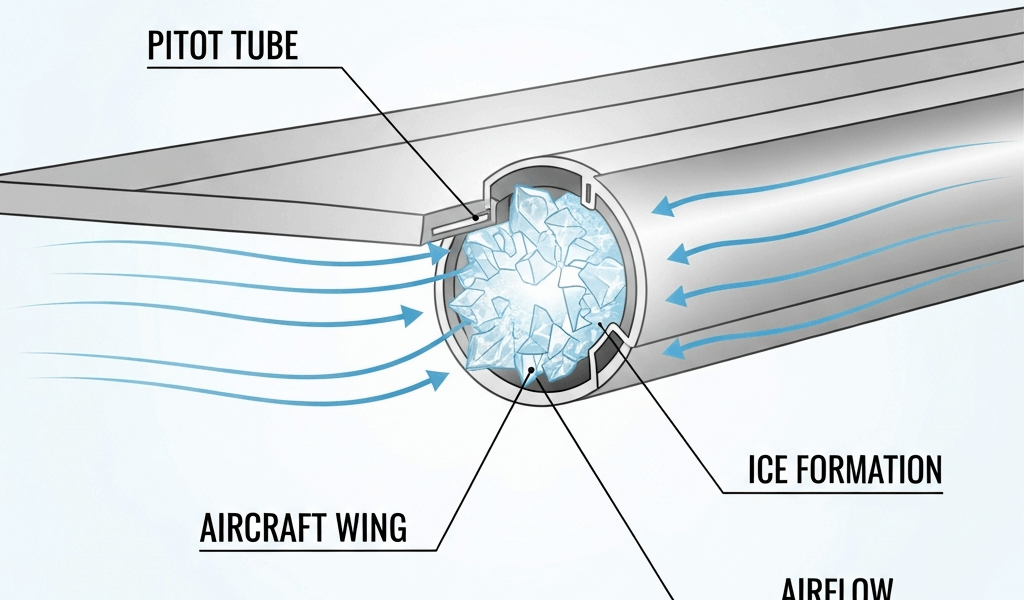
What a Blocked Pitot Tube Actually Does to Your Airspeed
Pitot tube icing has gotten complicated with all the misinformation flying around — especially about what actually happens to your airspeed indicator when things go wrong. Most pilots know the pitot tube measures airspeed. Fewer understand the pressure mechanics behind it. The tube compares ram air pressure from the forward-facing intake against static pressure from a side vent. Simple enough. But when ice enters the equation, the instrument doesn’t just quit. It lies to you — convincingly.
Here’s the scenario nobody walks you through. Ice seals the ram air opening but leaves the drain hole clear. Air trapped inside slowly bleeds out through that drain. Static pressure around the aircraft stays constant. Internal tube pressure drops. The differential widens artificially. Your airspeed needle climbs. You haven’t touched the throttle. The engine sounds the same. But the indicator says you’re accelerating. You’re not. You’re watching physics write fiction on your instrument panel.
Now seal the drain hole too. Both openings frozen. No air in, no air out. Pressure inside the pitot tube locks at whatever value existed the moment ice formed — a snapshot in time. As you climb, ambient static pressure falls. Your altimeter reads this correctly, dropping as expected. But the pitot system is frozen at that old pressure value. The airspeed indicator runs backward. Climbing makes it show slower. Descending makes it show faster. At that point, the thing functions less like an airspeed indicator and more like a confused altimeter wearing a costume.
I learned this distinction not in an aircraft but hunched over an NTSB report at 2 a.m. the night before a mountain crossing through visible moisture. Probably should have opened with this section, honestly. Most POHs confirm pitot heat exists. They skip the part about why the failure mode matters so much — and which failure mode you’re actually dealing with.
Conditions That Cause Pitot Ice More Often Than Pilots Expect
Supercooled water droplets are the culprit. Liquid droplets suspended in air below 0°C — they’re stable until something disturbs them. A pitot tube moving through a cloud at 120 knots disturbs them plenty. The danger window sits roughly between 0°C and minus 15°C outside air temperature in visible moisture, though icing has been reported well outside that band. Large droplets at minus 3°C can ice a pitot tube faster than pilots assume possible.
Rime ice is the specific threat here. Thicker than you’d expect. Rougher too. It doesn’t form gradually in a way that gives you warning time. It accumulates, then blocks, then your airspeed starts doing things that make no sense. NTSB general aviation data puts pitot system icing at roughly 0.3 to 0.5 percent of fatal accidents annually — small percentage, consistent pattern. Flight near clouds, temperature inside the icing envelope, pitot heat never switched on. Early spring and late fall see the most incidents, when cloud bases sit in that minus 5°C to plus 5°C window where many pilots figure they’re probably fine.
That assumption kills people. Don’t make my mistake of treating the temperature limits as precise boundaries. They’re not. If you can see moisture outside and OAT reads below 10°C, the pitot heat goes on. Not after the airspeed needle flinches. Not after you call the ATIS. Before you enter the clouds — preferably before you leave the ground.
Helicopter pilots run into this more than fixed-wing aviators. Hovering and slow transits through low cloud layers create prolonged exposure with minimal aerodynamic heating. Warbirds, aerobatic aircraft with unheated pitots — same story. But a stock Cessna 172 or Piper Cherokee operating in visible moisture below freezing sits squarely inside the risk envelope.
How to Recognize a Pitot Ice Problem While Flying
So, without further ado, let’s dive in — starting with what you’ll actually see from the left seat.
First symptom: erratic airspeed movement. Not a stable wrong number. Erratic. The needle oscillates, creeps left, jumps right. That’s ice forming, cracking partially, then reforming inside the probe. The pressure behind the reading keeps shifting.
Second symptom: airspeed climbs while the aircraft descends. VSI shows 500 feet per minute down. Altimeter confirms altitude loss. But airspeed reads higher than it did at altitude. You haven’t touched the throttle. Manifold pressure sits exactly where you left it. That airspeed increase is a ghost — the frozen-drain-hole scenario running in real time against your better judgment.
Third symptom: airspeed disconnects from pitch inputs entirely. Pull back. Nothing. Push forward. Nothing. The needle is frozen — not mechanically stuck, but pressure-locked. VSI still responds to your inputs. Altimeter tracks. Engine gauges read normal. Only the airspeed indicator has gone rogue.
The corrective cross-check sequence:
- Compare airspeed against VSI. Airspeed climbing while VSI confirms descent? Pitot problem. Full stop.
- Check power setting. Has it changed at all? Airspeed should respond to throttle — if it doesn’t, assume blockage.
- Scan altimeter and VSI together. If they agree with each other but contradict the airspeed indicator, believe the altimeter and VSI. Every time.
- If the autopilot is flying the aircraft, disconnect it immediately. Hand-fly using pitch and power. The airspeed indicator is no longer part of your instrument scan.
Ten seconds. That’s the full sequence. Ten seconds from confused to a working mental model of what’s happening.
Correct Pilot Response Step by Step
First, turn on pitot heat. On most general aviation singles, it’s a labeled switch on the electrical panel — usually near the lighting switches or de-ice equipment. Some turbocharged aircraft tie it into the induction heat system. Check your POH before you need this information at altitude.
Second, establish level flight on pitch and power alone. Forget the airspeed indicator exists. Set power to your normal cruise setting — whatever that number is for your specific aircraft and altitude. Pitch the nose level using the attitude indicator and the actual horizon if VMC. Watch VSI and altimeter for vertical drift. Hold heading with the directional gyro. Three instruments are still honest. Fly those three.
Third, wait. Thirty seconds minimum. Pitot heat melts accumulated ice gradually — it doesn’t vaporize it instantly. The needle may jump erratically as ice cracks and clears, then finally settle into a reading that matches your power setting and pitch attitude. When it does, trust it again — cautiously.
Fourth, tell ATC what’s happening. A pitot system failure in instrument conditions or controlled airspace is a reportable event. Controllers need to know your airspeed information is unreliable. They will work with you. Let them.
Fifth, plan your exit from the icing layer. Pitot heat manages the problem. It doesn’t eliminate it permanently. Climbing through minus 20°C in solid IMC while pitot heat works overtime to keep pace — that’s not a sustainable situation. Descend to warmer air or divert. The icing envelope is a place to pass through, not loiter in.
The biggest mistake pilots make is chasing the needle. Airspeed climbs, they reduce power. Airspeed drops, they add power. A pitot problem becomes a power management problem, then an altitude problem, then something much worse. The discipline required is simple to describe and genuinely difficult to execute: ignore the invalid instrument.
Preflight and Systems Checks That Catch This Before Takeoff
While you won’t need a full avionics overhaul, you will need a handful of minutes and a flashlight.
Remove the pitot cover — physically pull it off and look inside the tube. The ram air opening should be roughly pencil-eraser diameter and completely clear. Drain holes around the base need to be open as well. Insects block pitot tubes more often than pilots realize. Mud dauber wasps particularly favor them. One nest, one blocked tube, one very confusing takeoff roll. Use a small flashlight. Use your finger gently if needed. Confirm the path is clear.
Test pitot heat before every flight where OAT sits below 15°C or visible moisture appears in the forecast. Switch it on. Wait 30 seconds. Place your hand on the pitot tube. It should feel uncomfortably warm — not hot enough to burn, but warm enough that you wouldn’t hold it there. Room temperature after 30 seconds means the heating element has failed. That aircraft stays on the ground.
Find the pitot heat circuit breaker on your electrical panel. It should be labeled “Pitot Heat” or occasionally “AOA Heater” depending on aircraft vintage. Verify it hasn’t tripped. A tripped breaker hides the problem — the switch functions normally, the heat doesn’t. Know exactly where that breaker lives before you need to find it in turbulence at night.
First, you should review the pitot heat policy in your specific POH — at least if you fly in any weather that involves moisture below 10°C. Manufacturer guidance varies. Some recommend continuous operation in visible moisture. Others target known or forecast icing specifically. Most modern type certificates now recommend pitot heat activation below 10°C regardless of visible moisture, because supercooled droplets exist in clear air too. That guidance exists for a reason. Honor it.
Some Cirrus SR20 and SR22 models include a pitot heat functional check built into the starting checklist sequence — a brief test that confirms the heating element draws current and responds correctly. If your aircraft has this, use it every time. If the test returns a failure indication, troubleshoot before you taxi. The five minutes saved skipping this check isn’t worth the airspeed indicator lying to you at 8,000 feet in the clouds.
I’m apparently someone who learns preflight habits through near-misses rather than instinct, and a dedicated pre-IFR mental brief works for me while skipping it never does. Brief yourself on instrument cross-check priorities before every IFR departure. Know which three instruments carry the load if airspeed fails. The moment ice blocks your pitot tube is exactly the wrong time to puzzle out which gauge to trust. That decision should already be made — rehearsed, automatic, and waiting.



Stay in the loop
Get the latest aviation data updates delivered to your inbox.