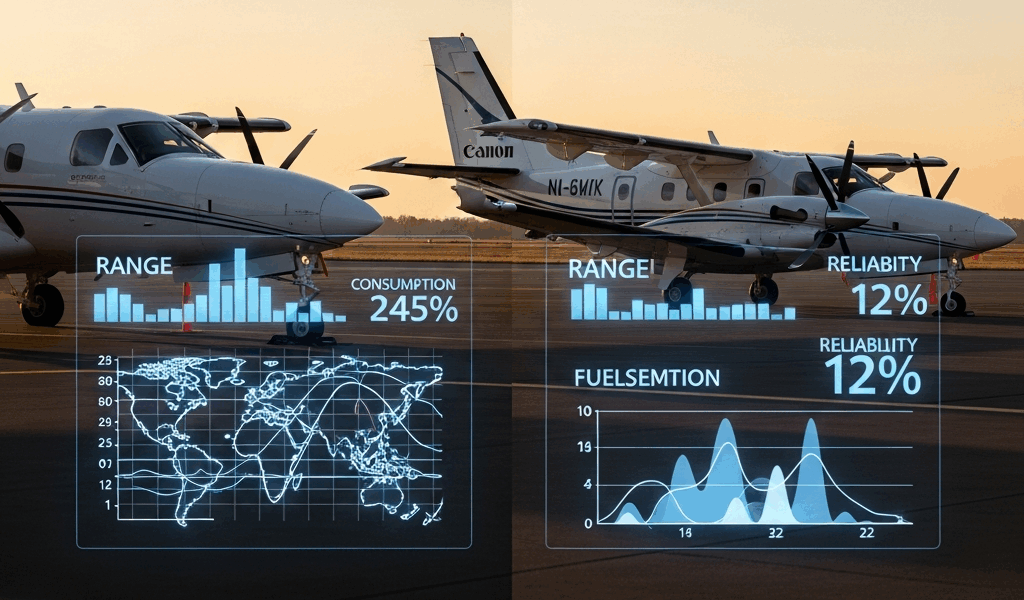
King Air 350 vs Pilatus PC-12 — What the Data Actually Shows
What You’re Actually Choosing Between
This comparison has gotten complicated with all the bad information flying around. Owner-pilot forums, charter operator huddles, random aviation blogs — most of what gets written about the King Air 350 versus the PC-12 is useless. Max range quoted at zero payload. PT6 TBO numbers dropped without context. A spec sheet comparison dressed up as analysis. That’s not what this is.
The real decision runs along three axes. Twin-engine certification versus single-engine. Two-pilot FAR 135 operations versus single-pilot-certified utility flying. And the economic canyon between a $4M used PC-12 and a $7M+ used King Air 350. Those aren’t cosmetic differences — they determine which aircraft fits your mission before you ever crack a spec sheet.
So, without further ado, let’s dive in.
Range and Payload — Where the Numbers Diverge
The King Air 350 posts an NBAA IFR range of roughly 1,650 nautical miles at max payload. Fly a realistic mission — six passengers, bags, call it 1,400 lbs in the cabin — and you’re planning around 1,450 nm in actual operations. The PC-12 NG, same mission profile, same six passengers, lands around 1,200 nm before fuel planning starts to bite. That’s a real gap. Not a rounding error.
| Metric | King Air 350 | Pilatus PC-12 NG |
|---|---|---|
| NBAA IFR Range (max payload) | ~1,650 nm | ~1,560 nm |
| Range with 6 pax / realistic payload | ~1,450 nm | ~1,200 nm |
| Max Payload | ~4,500 lbs | ~2,997 lbs |
| Cruise Speed (typical) | 312 KTAS | 270 KTAS |
But what is the PC-12’s single-engine configuration? In essence, it’s a planning variable that operators flying remote terrain take very seriously. But it’s much more than that. Flying full IFR over the Canadian Rockies or northern Alaska, the dispatch calculus changes in ways that don’t show up on any spec sheet. The PC-12 is not underpowered — the Pratt & Whitney Canada PT6A-67P produces 1,200 shaft horsepower — but single-engine extended overwater or over-mountainous-terrain operations require explicit operator risk acceptance. A twin-engine platform simply doesn’t demand that at the same threshold.
Past the 1,000 nm mark, the PC-12 starts trading payload for range in a meaningful way. The King Air 350 has more margin before that curve steepens. Two PT6A-60As give it a combined 2,100 SHP — plus more fuel volume to work with. That’s what makes the 350’s range performance endearing to operators who regularly push past 1,200 nm.
Operating Costs Per Hour — What Operators Report
Probably should have opened with this section, honestly. Cost is where most purchase decisions actually get made, and the data here is decisive enough to end arguments.
Conklin & de Decker’s 2023 operating cost bands — the industry baseline for charter operators and fractional programs — put the King Air 350 at approximately $1,850 to $2,100 per flight hour in direct operating costs at 400 hours annually. The PC-12 NG lands between $1,100 and $1,350 per hour on the same utilization model. That spread is not trivial.
Break it down by component:
- Fuel burn: The King Air 350 burns roughly 92 to 96 gallons per hour at cruise. The PC-12 NG burns approximately 52 to 58 GPH. At $6.50/gallon Jet-A — a reasonable 2024 average for U.S. FBO pricing — that’s $598/hr versus $351/hr in fuel alone. Every single hour.
- Engine overhaul accruals: Two PT6A-60A engines on the King Air 350, each with a recommended TBO of 3,600 hours and an overhaul cost in the $400,000–$450,000 range per engine. That’s an accrual of approximately $222–$250 per flight hour just for engines. The PC-12’s PT6A-67P carries a 5,000-hour TBO and a single overhaul cost near $350,000 — roughly $70 per hour accrual. The math is brutal for the King Air if you’re counting carefully. Don’t make my mistake of glossing over this line item early in your evaluation.
- Scheduled maintenance reserves: King Air 350 owners consistently report $280–$320/hr in maintenance reserves. PC-12 operators report $160–$200/hr, with Pilatus’s factory-backed PC-12 FLIGHTPATH program helping flatten unexpected cost spikes — at least if you enroll at delivery rather than retrofitting coverage later.
The honest number: operating a King Air 350 at 400 hours per year costs roughly $300,000–$350,000 more annually than a PC-12 NG at the same utilization. That’s not a rounding difference. That’s a second aircraft payment.
Dispatch Reliability and Maintenance Footprint
This is where the data starts separating this piece from everything else written about this comparison.
The PT6 engine family powers both aircraft. Over 400 million flight hours accumulated across all variants. Legitimately the most reliable turboprop powerplant ever built — and that is not marketing language. Unscheduled engine removal rates for PT6 variants in turboprop applications run below 0.1 per 1,000 hours in current fleet data reported to JETNET and tracked through Aviation Safety Information Analysis and Sharing program submissions.
So the single-engine dispatch risk argument against the PC-12 — at least framed around engine failure probability — is largely theoretical in modern fleet operations. Where it becomes real is regulatory and psychological. FAR 135 charter operators face specific single-engine IFR approval hurdles that twin operators simply don’t encounter. And some charter clients won’t board a single-engine turboprop regardless of the statistics.
The King Air 350 has a deeper MRO network in North America. Full stop. Textron Aviation’s service center network covers 26 U.S. locations, with AOG support response built into the Textron Aviation Customer Care program. Park a King Air 350 in Tulsa on a Friday afternoon with a fuel control unit issue and you have a realistic path to resolution before Monday.
I’m apparently more MRO-obsessed than most buyers going into a purchase decision, and this asymmetry matters to me while vague promises of “manufacturer support” never quite satisfy me the same way. The PC-12’s MRO coverage in the U.S. interior is thinner than its excellent reputation suggests. Pilatus has authorized service centers — but the concentration is coastal and regional. An AOG event with a PC-12 in a secondary market can run 5 to 7 days waiting on parts routed through Pilatus’s North American distribution. The PC-12 FLIGHTPATH contract helps, but it doesn’t conjure proximity where proximity doesn’t exist.
Fleet dispatch reliability rates — where operators report them to aggregators like ARGUS International — show King Air 350 fleets averaging 98.2% on scheduled charter operations. PC-12 fleets report 97.6%. Small gap. But at 400 hours per year, that represents roughly 2.4 additional unscheduled ground days annually. Plan accordingly.
Which Aircraft Wins for Which Mission Profile
No hedging here. The data is clear enough for straight answers.
Owner-Flown, Single-Pilot, Short-to-Medium Legs Under 800 nm
PC-12 wins. Single-pilot certification, lower direct operating costs, and Pilatus’s ergonomics for solo operations make it the dominant choice in this profile. The PC-12 NG’s avionics suite — Honeywell Primus Apex with integrated autoflight — is genuinely better optimized for single-pilot IFR than the King Air 350’s Collins Pro Line Fusion in practical day-to-day flying. Lower fuel burn on short legs means the cost advantage compounds fast. First, you should run a 12-month leg analysis against your actual routes — at least if you fly primarily under 800 nm and cost discipline matters.
FAR 135 Charter, High Utilization, Passenger-Facing Operations
King Air 350 wins. Two-pilot ops satisfy charter client expectations. The MRO network supports high-utilization schedules without the AOG anxiety. Cabin volume matters too — 54.6 cubic feet of baggage space versus the PC-12’s 40 cubic feet when you’re loading six passengers with real luggage for a three-day business trip. The higher operating cost gets partially offset by premium charter rate justification on a twin-engine platform. That is because clients booking twin-engine turboprop charters routinely accept higher hourly rates, and operators can price accordingly.
Remote Strip Access, Backcountry, Gravel Operations
PC-12 wins decisively. Designed with austere operations in mind from the ground up — 2,500-foot field performance, robust landing gear, a cargo door configuration the King Air 350 simply can’t match. STOL utility in this profile isn’t a competition. It’s a category the PC-12 owns.
Flying owner-operated under 900 nm regularly with cost discipline driving your operation? Stop reading and configure the PC-12. Building a FAR 135 charter program in a mid-sized U.S. market where client optics and MRO access drive uptime? The King Air 350 earns its premium. The mission tells you which aircraft to buy — the spec sheets just confirm it.



Stay in the loop
Get the latest aviation data updates delivered to your inbox.