Why Your Compass Swings More Than It Should in Turns
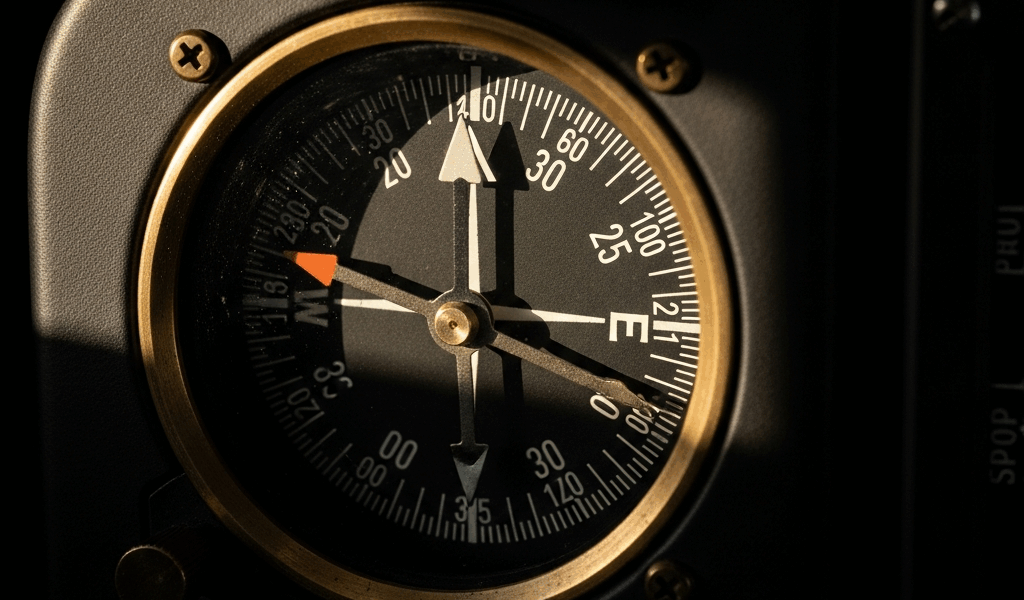
Magnetic compass errors have gotten complicated with all the conflicting information pilots receive. I learned about them the hard way—watching my heading indicator and compass give completely different readings during a steep turn to a northerly heading. The needle didn’t just move smoothly; it oscillated wildly, overshooting by 15–20 degrees before settling. That’s the magnetic compass behaving exactly as its physics dictates, but it’s infuriating when you’re trying to maintain a precise heading.
Two distinct errors plague aircraft compasses during maneuvers: acceleration error and turning error. Probably should have opened with this section, honestly, because understanding the difference is how you stop overcorrecting and second-guessing yourself in the cockpit.
Acceleration error strikes when you increase or decrease airspeed. The compass card lurches forward or backward relative to the lubricating fluid sloshing inside the compass housing—causing a temporary heading indication that’s completely wrong. In a northerly turn, the effect is minimal. In a southerly turn, the compass lies to you in a big way. You’re cruising at 90 knots, decide to bump it to 110, and suddenly the compass swings 5 degrees left of your assigned heading.
Turning error is the real culprit in most overcorrection scenarios. When you roll into a turn, the compass doesn’t track your actual heading change smoothly. Instead, it lags, overshoots, and oscillates like it’s possessed. Pilots trained on older aircraft or those unfamiliar with the compass’s quirks push the rudder harder and harder, convinced the plane isn’t turning to heading—but the plane is fine. The compass is just lying about where you’re going.
The Physics Behind Compass Lag and Oscillation
The compass card inside your instrument floats in a housing filled with mineral oil. Suspended by a jeweled bearing—the same type you’d find in a mechanical watch—it aligns with Earth’s magnetic field. Sounds simple. It isn’t.
Picture the compass card as a spinning top sitting in liquid. When you roll the aircraft into a turn, the card’s suspension system can’t instantly follow your bank angle and heading change. The card lags behind reality. As the aircraft continues turning, the inertia of the liquid and card creates overshoot—the needle shoots past the actual heading you’re turning to, then oscillates back and forth like a pendulum damping out over several seconds.
The root cause is magnetic dip. Earth’s magnetic field doesn’t run horizontal everywhere. In the Northern Hemisphere, the magnetic field dips downward at an angle called inclination. In most U.S. flying, that dip sits around 60–70 degrees. The vertical component of that magnetic field pushes one end of the compass card downward during turns, creating a tilting effect inside the housing that shouldn’t exist but does.
Think of it this way: imagine a compass card mounted on a pivot, and the entire aircraft tilts sideways. The magnet inside the card wants to align with Earth’s magnetic field, but as the aircraft banks, the card’s effective balance shifts. The fluid damping should stabilize it, but the inertia in the system overshoots the equilibrium point. The result is a needle that swings past where it should be, then vibrates back toward true heading like it’s making up its mind.
The oscillation you see isn’t a malfunction — it’s the compass card’s mechanical response to a rotating reference frame. Your heading indicator, powered by the vacuum pump and gyroscopic inertia, has zero problem with turns. It just precesses slowly over time. The compass is honest and driftless but sensitive to acceleration and turning dynamics. That’s why experienced pilots cross-check constantly instead of trusting one instrument.
How to Recognize Acceleration Error vs. Turning Error
Acceleration error happens in straight and level flight or shallow banks. Speed up on a northerly heading, and the compass card moves south (backward) temporarily. Slow down, and it moves north (forward). The effect flips if you’re on a southerly heading — the errors reverse sign. This is the easier error to spot because it occurs in straight flight. You’re accelerating to cruise at 2,500 feet, eyes on the compass, and it suddenly swings 5 degrees left of your assigned heading. That’s acceleration error at work.
Turning error is what we’re really talking about here. Roll into a turn to any heading, and the compass lags initially, then overshoots. On northerly headings (000–090 degrees and 270–360 degrees), turning error is minimal. The compass almost tracks your turn correctly. On southerly headings (090–270 degrees), the error is pronounced. Turn to a heading of 180 degrees, and the compass will lag badly, then swing 15–25 degrees past your target before settling.
Here’s how to diagnose which error you’re experiencing: If the compass misbehaves during speed changes in level flight, that’s acceleration error. If it acts up during the turn itself — lagging at the start, then overshooting — that’s turning error. Most overcorrection happens because pilots mistake turning error for a slower-than-expected turn rate. They push more rudder, aggravating the oscillation instead of solving it.
The Compass Turn Rule Pilots Actually Use
The practical technique that stops overcorrection is simple: compensate for turning error by rolling into your turn less steeply and turning more smoothly. But that’s vague, so here’s the concrete method I use and teach in the cockpit.
When turning to a northerly heading (roughly 330–030 degrees), standard rate or shallow bank turns work fine. The compass lag is minimal, and you won’t overshoot by more than 5–10 degrees even if you use moderate roll rates. The built-in compass damping handles it without intervention.
When turning to a southerly heading, slow your roll rate. Instead of a 20-degree bank in 5 seconds, bank to 10–15 degrees over 8 seconds. Watch the compass needle. It will still lag, but the slower turn rate reduces the card’s inertia and dampens the overshoot. By the time you roll out, you’ll be within 5 degrees of your assigned heading. This is the technique that actually works in the cockpit: gentle roll, patient turn, early cross-check with your heading indicator instead of staring at the oscillating compass.
Some instructors teach the UNOS rule — Undo, North, Opposite, South. It’s a memory device to recall acceleration error behavior, but it doesn’t directly address turning error correction. The rule says: undo the error direction on northerly headings; apply the opposite correction on southerly headings. In practice, I rely on smooth, slow turns to southerly headings and standard rates northerly. It’s more intuitive than mnemonics, and honestly, I forget UNOS half the time anyway.
Step-by-step for your next flight: Assign yourself a southerly heading like 180 degrees. Roll into a 15-degree bank over 6 seconds. Resist the urge to increase bank angle when the compass lags — that’s the trap. Watch it creep toward 180. It will overshoot slightly. Roll out gently 5 degrees before the target heading appears, and let inertia carry you to it. You’ll land on heading with one correction instead of three overcorrections and a frustrated grunt.
When to Trust Your Heading Indicator Instead
The compass is accurate over time and completely immune to drift — but unreliable moment-to-moment in turns. The heading indicator (or directional gyro, DG) is rock-solid in turns and level flight but will precess 10–15 degrees per hour, drifting away from magnetic north. That’s just how these older instruments behave.
The rule: use the heading indicator to fly the turn. Use the compass to set the heading indicator before flight and periodically in level flight to catch accumulated gyro drift. Never trust the compass to be accurate during a turn. Wait until straight and level flight before using it to cross-check your heading indicator’s accuracy.
If your heading indicator reads 185 degrees and your compass reads 175 degrees while you’re rolling out of a southerly turn, the heading indicator is correct. The compass is still settling. Give it 30 seconds of level flight, and both will align. The compass hasn’t failed; it’s just behaving as the physics dictates, and the liquid inside is still catching up to reality.

Stay in the loop
Get the latest aviation data updates delivered to your inbox.