How Altimeter Settings Drift During Preflight
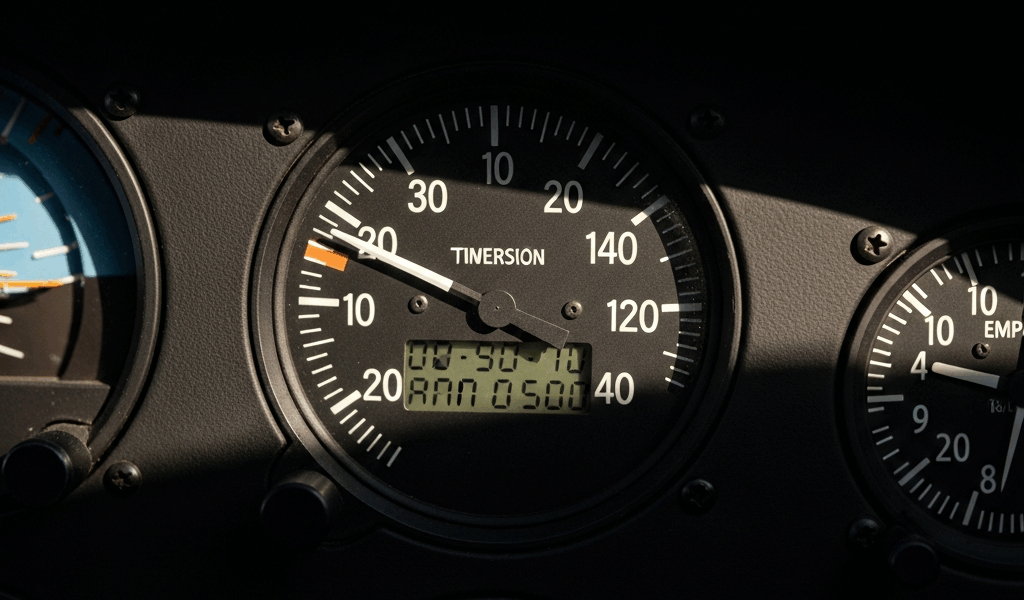
Altimeter setting errors have gotten complicated with all the confusion flying around cockpits, and I learned this lesson the hard way back when I was building hours in a Cessna 172. You set your altimeter in the hangar where it’s calm and comfortable. Everything reads perfectly. Then you taxi out, contact ATIS, hear a new QNH setting, and suddenly realize you never adjusted the Kollsman window during your actual runup — at least if you want to stay accurate.
Here’s what actually happens. The Kollsman window is that small adjustment knob on the face of your altimeter — usually located at the 3 o’clock position. Rotate it, and you’re changing the reference pressure your altimeter measures against. QNH is the corrected barometric pressure at sea level for your location. Every airport publishes it. Weather stations update it hourly, sometimes more often.
But what’s the mistake? In essence, pilots set altimeter to field elevation in the hangar, taxi out, receive a new ATIS report with different QNH, and then never actually twist that knob again. By the time you’re at 2,000 feet, your altimeter shows 1,950. By 5,000 feet, you’re reading 4,850. The discrepancy grows steadily. ATC notices. Your autopilot notices. Your crew alerting system notices.
In a Piper Archer, I watched this unfold during a cross-country flight. Pilot set altimeter to 2,100 feet (field elevation) at departure. New airport was 400 miles away. Weather had shifted significantly. The QNH difference was nearly 0.3 inches of mercury — a real gap. By arrival, the altimeter read 2,050 feet when they were actually at 2,100. Altitude reporting error flags lit up on multiple systems. ATC asked for a readback. That’s what makes altitude discrepancies endearing to absolutely no one. The whole situation created unnecessary workload and doubt when the fix was simply dialing in the correct QNH.
Probably should have opened with this section, honestly. The Kollsman window adjustment is the first thing pilots learn, and it’s the first thing they forget to confirm during that critical runup phase.
Mechanical Failures That Hide Altitude Changes
Stuck static ports account for more altimeter failures than any other mechanical cause — I’m apparently the type who finds this detail important, and maintenance logs confirm it. Your pitot-static system uses a static port, those tiny holes on the fuselage that sense ambient air pressure. That pressure feeds into your altimeter, VSI, and airspeed indicator. When the static port clogs with ice, moisture, insects, or even a misplaced pitot cover, your altimeter freezes.
A Cirrus SR22 I flew had a partially blocked static port discovered during preflight. The altimeter would climb for a few hundred feet, then plateau. It looked normal at first. We were at 3,500 feet when we noticed the VSI — vertical speed indicator — stopped changing. Climbing. Not losing altitude. Just stuck at zero vertical speed. We diverted, landed safely, and maintenance found a spider web inside the static port drain. That was 2014.
That wasn’t a reading error. That was the altimeter doing exactly what physics demanded — it couldn’t change because the pressure input stopped changing. The system worked perfectly given what it received, which was nothing.
Leaking aneroid capsules are mechanical failures that cause gradual drift. The aneroid capsule is a sealed metal wafer that expands and contracts with pressure. As it moves, it drives the altitude needle. When the seal fails, the capsule loses its reference pressure. The altimeter reads progressively wrong. It doesn’t jump wildly. It drifts slowly, which makes it insidious. You might not notice 150 feet of creep over an hour — then suddenly 300 feet by the next flight.
Pitot-static system blockages come in varieties, each with its own personality. Pitot tube icing affects airspeed more than altitude, but pitot blockage can cascade into static port issues if the lines share common routing. Heat tape failures on pitot tubes in icing conditions create a domino effect. You lose airspeed indication first, but secondary systems fail shortly after.
The key distinction: mechanical failures don’t care about pilot technique. A stuck static port will trap your altimeter at whatever altitude you were at when it froze. No amount of Kollsman window adjustment fixes that. You need maintenance, period.
Misreading the Three Altimeter Needles
Analog altimeters confuse pilots in ways digital displays never will. Three needles. Three different scales. 100 feet, 1,000 feet, 10,000 feet — they all tell the story together, but reading them wrong happens constantly.
The thin needle represents 100-foot increments. It completes one full rotation every 1,000 feet. Watch it spin as you climb — it’s hypnotic if you stare. The thicker needle shows 1,000-foot increments. It completes one full rotation every 10,000 feet. The triangular needle is the 10,000-foot pointer. It’s the slowest and moves the least, barely creeping around the dial.
Common mistake: new pilots read the 100-foot needle at 3 o’clock, the 1,000-foot needle at 2 o’clock, and try to combine them as 3,200 feet. Wrong approach entirely. You read them sequentially, like clock hands stacked on top of each other. The 10,000-foot needle passes numbers like “0,” “1,” “2” representing 0, 10,000, and 20,000 feet respectively. The 1,000-foot needle shows which thousand you’re in. The 100-foot needle shows final increments within that thousand.
Let me give a concrete example from experience. You’re climbing and the needles read: 10,000-foot pointer between 1 and 2, 1,000-foot needle at 4, 100-foot needle at 7. Your altitude is 14,700 feet. The needle positions are read left to right, biggest to smallest: ten-thousand zone (between 10k and 20k), one-thousand zone (4,000 feet in that zone), hundred-foot zone (700 feet into that thousand). Add them: 10,000 + 4,000 + 700 = 14,700 feet.
In a Cessna 182, I made this error during initial training. I insisted I was at 6,500 feet when I was actually at 5,600 feet. My CFI asked me to read the altimeter aloud. I described needle positions but got the sequence wrong — started with the small needle instead of the big one. Once I read them as a hierarchy, biggest number first, then drill down progressively, it clicked immediately.
Altitude Discrepancy Alerts and What They Mean
Modern glass cockpits display both barometric altitude (what your pitot-static system reports) and GPS altitude (what satellites tell you). These almost never match exactly — temperature, pressure anomalies, and GPS error margins create natural variance. Aircraft equipped with Garmin GFC 500 autopilots or Avidyne systems monitor this gap continuously.
While you won’t need to understand satellite triangulation, you will need a handful of thresholds. Most crew alerting systems flag a discrepancy when barometric and GPS altitude differ by 300 feet or more. Some systems use 200 feet. Check your aircraft manual — manufacturers vary. When the flag lights up, your altimeter has either drifted significantly, the static system has failed partially, or GPS altitude is experiencing unusual error, which is rare but possible.
What you do when the alert activates: Level flight, confirm your current altitude by comparing to terrain, landmarks, or recent ATC altitude assignments. If you’re at 4,500 feet as assigned and your barometric reads 4,200 feet while GPS shows 4,510 feet, you have an approximately 300-foot discrepancy. This usually signals a static port issue developing or an altimeter mechanical problem beginning its progression.
Declaration to ATC depends on severity and aircraft mission. In IFR conditions, an altitude discrepancy is serious — don’t make my mistake of assuming it’s just a sensor glitch. You report it immediately. VFR? Depends on your visual reference. If you can see the ground and confirm you’re at the correct altitude visually, you can continue with caution and land to investigate. If you can’t see ground, land immediately.
Preflight Checks That Catch Altimeter Errors Early
Your runup checklist includes an altimeter check for one reason: it catches problems before they become emergencies — at least if you actually perform it thoroughly.
Step one: Set altimeter to field elevation using ATIS or windsock information. Most airports display elevation on the sleeve clearly. For example, if you’re at a 3,250-foot-elevation airport, rotate the Kollsman window until the altimeter reads 3,250 feet precisely. This is your baseline, your starting point, your truth for the day.
Step two: Verify the reading is within 75 feet of field elevation. FAA rules state your altimeter cannot be more than 75 feet off at any given altitude — this is non-negotiable. If you’re at 3,250 feet field elevation and your altimeter reads 3,340 feet after adjustment, that’s 90 feet off. You fail the check. You don’t fly IFR. VFR flight is your call, but it’s degraded and you’re accepting additional risk.
Step three: The 100-foot rule. After setting altimeter to field elevation, it should hold that value for at least one minute before departure. Watch the needle closely. If it creeps up or down, you have a system leak — something’s wrong internally. Minor creep, less than 10 feet over a minute, is acceptable under some conditions. More than that? Suspect a failing aneroid capsule or leak in the plumbing. Don’t ignore it.
Step four: Static system check. Most modern aircraft have a manual static pressure selector. Position it to flight, then observe your VSI, airspeed, and altimeter for three minutes while stationary. They should be stable. No climbing, no descending, no sinking feeling at all. Stability confirms static system integrity from source to display.
These checks take five minutes. Seriously, five minutes total. They’ve prevented countless altitude-related incidents and accidents because pilots catch the problem on the ground, not at 5,000 feet over a populated area where fixing it becomes exponentially harder.

Stay in the loop
Get the latest aviation data updates delivered to your inbox.