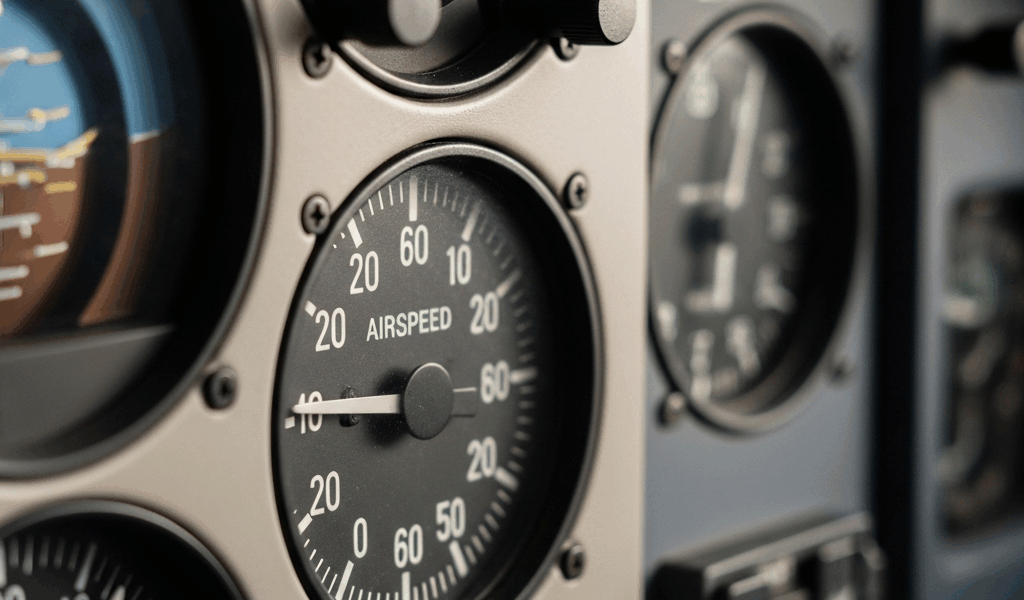
What Airspeed Lag Actually Is
I’ve watched more than a few student pilots chase a sluggish airspeed indicator on approach, completely convinced the aircraft had a serious problem. What they were actually experiencing was airspeed lag—and it’s totally normal. Here’s the thing upfront: your airspeed indicator lags in slow flight because pressure changes move through the pitot-static system at a glacial pace when you’re flying slow.
The mechanics of it are straightforward. Your pitot tube collects ram air pressure. That pressure travels down a tiny tube — usually 3/16 inch copper or stainless steel — straight to the airspeed indicator, which is basically just a differential pressure gauge doing its job. A static port measures atmospheric pressure separately. The difference between these two pressures moves a needle across your dial.
At slow airspeeds, though, that pressure differential becomes microscopic. We’re talking inches of water column, not pounds per square inch. When you reduce power and airspeed starts dropping, the pressure change creeps down the tube. Really, really slowly.
In actual flying, you’ll experience about 2 to 3 seconds between an airspeed change happening and what the needle finally shows you. That sounds trivial until you’re sitting 200 feet above the ground on a 6-degree glide slope and the needle won’t cooperate.
This is nothing like pitot icing or blockage — I’ll get into that later. Lag is the system working exactly right but losing to physics. It’s also not the same as mechanical hysteresis in those old round-dial indicators, though those definitely make it worse. The Garmin G1000 NXi reduces lag through software smoothing and faster sampling rates, but even glass cockpits show some real-world lag — they just hide it better.
Why It Happens in Slow Flight Specifically
Airspeed indicators measure dynamic pressure. That’s the pressure your aircraft creates by moving through the air. The formula is simple enough: dynamic pressure equals half the air density times velocity squared. See that squared term? It changes everything.
At 100 knots, you’re generating way more dynamic pressure than at 50 knots. At 50 knots, you’re already in twitchy territory. The pressure differential between your pitot tube and the static port shrinks dramatically. Instead of a strong pressure difference pushing the needle forward quickly, you’ve got a barely-there margin fighting against needle friction, spring tension, and the weight of the needle assembly itself.
Probably should have opened with this section, honestly — it’s the actual reason slow flight is where lag becomes obvious.
Get near stall speed and things deteriorate fast. A Cessna 172 stalls around 33 knots clean, maybe 27 knots in a full slip. Near stall, the dynamic pressure differential gets so small the needle barely moves forward or backward. You could be within 2 knots of stalling, and the airspeed indicator is still lazily catching up to reality.
The tubing itself doesn’t help. Pushed by tiny pressure differentials, air inside the pitot-static lines travels at finite speed. There’s compliance in the system too — rubber fittings, flexible tubing sections, even the diaphragm inside the indicator expanding and contracting. All of it adds dead time.
Temperature swings matter as well. Cold air is denser, warm air is thinner. The pressure differential changes based on altitude and temperature, which shifts what the indicator reads before lag even enters the picture. A cold morning departure shows different lag characteristics than a hot afternoon flight.
How This Breaks Pilot Decision Making
Let me walk through a concrete scenario — this is where lag transforms from interesting technical trivia into genuine operational danger.
You’re flying a standard approach in a Piper Cherokee, trimmed for 1000 feet per minute descent at 70 knots. You pull power to slow down for landing. The airspeed indicator shows 68 knots. Seems fine. But your actual airspeed is dropping faster than the needle indicates. You’re really at 62 knots and descending.
The instrument lags. It’s still showing 65 knots three seconds later when you’re already down to 58. The needle hasn’t moved much — so you make a pitch adjustment you shouldn’t need. Nose down slightly to maintain 65. Now you’re in a steep descent and accelerating.
That whole cascade happened because you trusted the indicator’s current reading instead of recognizing the lag and trusting the trend.
Even worse: you’re on short final at a grass strip. Headwind is barely there, you’re slower than ideal already. You’re staring at the airspeed indicator reading 45 knots. The needle isn’t moving. You figure you’re stable. Actually, you’re at 38 knots and sinking. The indicator hasn’t caught up yet. By the time it does, you’re stalled with ground 50 feet below.
This isn’t academic. It’s happened.
Lag stacks with other errors too. Misread the altimeter — happens way more than it should — or misinterpret a slightly off attitude indicator in poor light, and airspeed lag becomes error number three in a chain that ends badly. What should be a straightforward approach turns into a series of over-corrections based on bad information.
Round-dial analog indicators show lag more obviously than glass cockpits. The Garmin G1000 uses digital pressure sampling, smooths the data, and updates more often, cutting lag down to roughly 1 second. If you’re moving from steam gauges to glass, you’ll actually feel more confident in slow flight — which is good, but risky if it tricks you into flying slower than you should because you trust the indicator too much.
How to Fly Through Airspeed Lag
The fix isn’t hard, but it demands discipline and a different relationship with the airspeed indicator.
Cross-check with everything else. Vertical speed indicator, altimeter trend, attitude indicator, and what you see outside — they all show what’s actually happening. In slow flight, these instruments beat airspeed alone every time. If the VSI shows 500 feet per minute down and the airspeed reads 65 steady, but your altimeter is descending faster than your descent rate should allow, the airspeed indicator is lagging. You’re slower than it says.
Plan your pitch and power. This matters most. Don’t chase the needle. Plan pitch and power based on the flight phase, then adjust gradually. On approach, if you want 500 fpm descent at 60 knots, set the pitch and power that experience tells you will deliver that, then verify everything else. Trust your procedure more than you trust the needle’s current position.
Trust the trend, not the current reading. If the needle is moving toward your target airspeed, you’re fine even if it hasn’t arrived. If the needle is steady but everything else suggests you’re slow, you’re slow. The direction the needle is moving matters more than where it sits right now during slow flight.
Scan the airspeed indicator more often. In cruise, every 10 seconds is fine. In slow flight, look every 3 seconds, but don’t fixate on the current value. Look at which way the trend is heading and immediately compare it to vertical speed, altitude, and attitude.
Learn your aircraft’s individual lag pattern. A well-maintained Cessna 172 lags differently than a Piper Cherokee, which lags differently than a Bonanza. Fly a few approaches in your regular aircraft and feel how it behaves. You’ll build intuition for lag.
Glass cockpit pilots get digital filtering as an advantage, but don’t rely on it completely. The G1000 samples the pitot-static system 10 times per second and applies smoothing algorithms. Lag goes down, but the aircraft’s actual performance hasn’t changed. You still need to cross-check.
When to Get Your Pitot-Static System Checked
Normal lag is predictable and consistent. An erratic airspeed needle that bounces around — especially one that fluctuates more than 5 knots — signals something wrong. That could mean a partial pitot tube blockage, water in the lines, or tubing that’s deteriorating and causing pressure leaks.
A sudden airspeed jump, especially one that doesn’t settle back down quickly, suggests blockage risk. If you’re at altitude and the needle suddenly jumps 10 knots for no reason, suspect contamination in the static line or pitot tube.
Slow, steady, predictable lag is normal and fine. That’s what we’ve been discussing. Inconsistent lag or dramatic shift from one flight to the next means get maintenance involved.
The FAA requires pitot-static system certification under 14 CFR Part 43 Appendix E. Your mechanic has to do this at set intervals — usually annual inspection, sometimes more often for busy aircraft. The test means pressurizing the static and pitot lines to specified levels and checking for leaks and blockages.
When you schedule this, tell your shop to specifically test the tubing itself. Older copper tubing sometimes gets small leaks. Stainless is better but still needs looking at. A tiny pinhole in the pitot line 30 feet up the wing won’t show on a pressure test but will absolutely destroy performance.
Between inspections, simple preflight work helps. Look for visible damage to the pitot probe — cracks, bent fins, dirt or debris. Listen during flight for strange sounds that might mean blockage. Most important: fly attentively in slow flight and notice if the lag pattern changes. If it suddenly gets worse, get it inspected before your next long cross-country.



Stay in the loop
Get the latest aviation data updates delivered to your inbox.