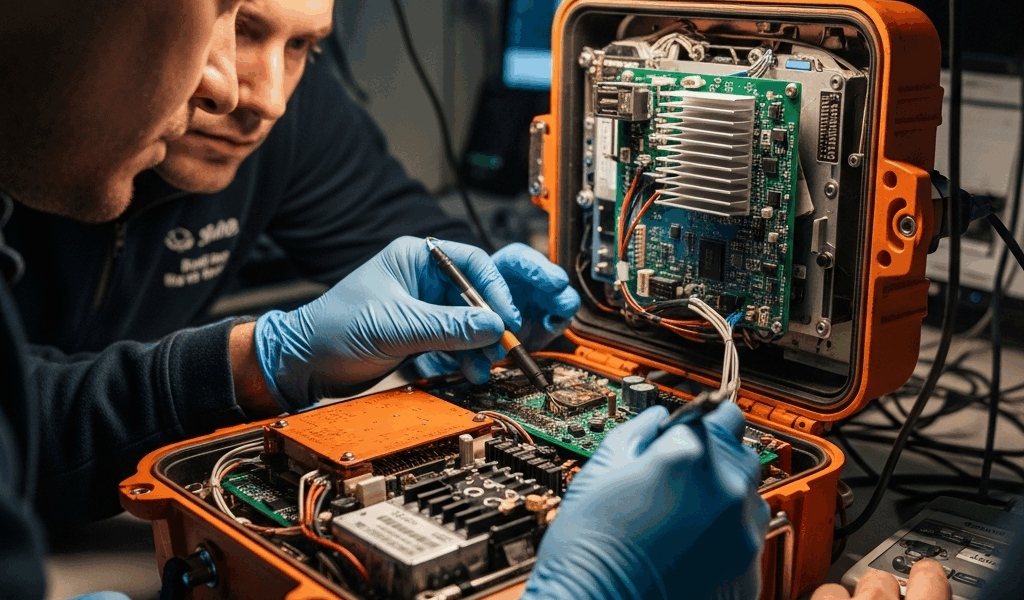
Every commercial flight generates a continuous stream of data — altitude, airspeed, engine temperatures, control surface positions, heading, vertical acceleration — all captured multiple times per second by a device most people only hear about after something goes wrong. The flight data recorder, paired with the cockpit voice recorder, forms the investigative backbone of aviation safety. Together they have helped reconstruct thousands of accidents and driven design changes that have made flying the safest form of transportation on earth.
But the technology behind these recorders has changed dramatically since their invention, and the biggest shift — streaming flight data in real time — is rewriting the rules of what a “black box” even needs to be.
What Flight Data Recorders Actually Record
A modern flight data recorder (FDR) captures a minimum of 88 parameters as mandated by regulations, but newer aircraft types record far more. Boeing 787s and Airbus A350s can log over 1,000 distinct data channels. The FDR retains the last 25 hours of flight data on a continuous loop — once 25 hours of recording fills the memory, it begins overwriting the oldest data.
The mandatory parameters include the basics: time, pressure altitude, indicated airspeed, heading, normal acceleration (G-forces), pitch attitude, roll attitude, radio transmission keying, thrust of each engine, trailing edge flap position, leading edge flap position, thrust reverser position, ground spoiler position, and outside air temperature. These 88 parameters give investigators enough to reconstruct the physical path of the aircraft through space and the state of its systems at any given moment.
The additional channels on modern aircraft go much deeper: individual hydraulic system pressures, electrical bus voltages, autopilot mode selections, autothrottle commands, landing gear door position, bleed air valve status, and hundreds of engine-specific parameters. Each data point is sampled at a rate appropriate to its behavior — slowly changing values like outside air temperature might update once per second, while rapidly changing values like control surface deflection sample multiple times per second.
All of this data flows through the Flight Data Acquisition Unit (FDAU), which sits at the front of the aircraft near the avionics bay. The FDAU collects raw sensor signals from systems throughout the airplane, digitizes them, formats them into a standardized data stream, and routes that stream to the FDR mounted in the tail section. The FDAU is the single point where all flight data converges before being committed to the recorder’s memory.
The cockpit voice recorder (CVR) operates independently. It captures audio from cockpit area microphones and individual crew headset channels, retaining the last two hours on a continuous loop. Modern CVRs record on solid-state memory — the old magnetic tape units that degraded over time have been phased out. The audio captures not just crew conversation but ambient sounds: engine noise changes, warning horns, clicks from switch positions, the sound of landing gear extending, and the distinctive tone of stick shaker activation. Investigators can extract remarkably precise timeline data from these ambient sounds alone.
Why They Survive Crashes
Flight recorders are engineered to survive forces that destroy the aircraft around them. The crash-survivable memory unit (CSMU) at the core of every modern recorder is wrapped in stainless steel, insulated against heat, and housed in an aluminum outer shell. The specifications are severe: the unit must survive an impact of 3,400 Gs, a fire burning at 1,100 degrees Celsius for 30 minutes, and immersion in saltwater at a depth of 6,000 meters for 30 days.
The recorders are painted bright orange — not black, despite the universal nickname. The color ensures visibility in wreckage fields where everything else may be burned, twisted, or fragmented. Each unit also carries an underwater locator beacon (ULB) that activates on contact with water and transmits an acoustic pulse at 37.5 kHz for a minimum of 30 days. After the disappearance of Malaysia Airlines Flight 370 in 2014, ICAO mandated that new ULBs extend their battery life to 90 days — a direct response to the two-year search required to locate MH370’s recorders on the ocean floor.
Placement matters. Both recorders are mounted in the aircraft’s tail section, as far aft as practical. Crash dynamics research shows that the tail structure experiences lower deceleration forces than the forward fuselage in most impact scenarios. The forward section absorbs energy first, giving the tail section — and the recorders mounted there — a marginally better survival probability.
How Investigators Read the Data
When the NTSB or another investigation authority recovers flight recorders, the CSMUs are transported to a laboratory — in the US, the NTSB’s lab in Washington, DC. The memory chips are extracted and connected to a readout station that decodes the raw binary data using the aircraft’s data frame layout document. This document maps each bit position to a specific parameter, its engineering units, and its sampling rate.
The decoded data is plotted on time-synchronized charts. Investigators can see exactly when the autopilot disconnected, when the stick shaker activated, what the engine N1 and N2 speeds were at every moment, and how the crew’s control inputs related to the aircraft’s actual flight path. The FDR does not interpret events. It records raw data. Interpretation is the investigator’s job.
The CVR audio is transcribed and time-aligned with the FDR data. When the FDR shows a sudden pitch-up at 14:23:07, the CVR might reveal the captain calling “rotate” or a stick shaker activation tone at the same timestamp. This cross-correlation between data and audio is what transforms raw numbers into a coherent narrative of what happened and why.
Modern investigation teams also use the FDR data to drive flight animation software. Programs like NTSB’s own visualization tools and third-party platforms can replay the flight in 3D, showing the aircraft’s attitude, trajectory, and system states in real time. These animations are used both for analysis and for communicating findings to non-technical audiences during public hearings.
The Push for Real-Time Streaming After MH370
The disappearance of Malaysia Airlines Flight 370 on March 8, 2014, exposed the fundamental limitation of physical flight recorders: if you cannot find them, you cannot read them. The aircraft vanished over the Indian Ocean with 239 people aboard. Despite the most extensive maritime search in history, the main wreckage has never been located. The FDR and CVR remain on the ocean floor somewhere in one of the most remote stretches of water on earth.
MH370 accelerated a conversation that had been simmering in the industry for years: why are we still relying on a physical box in the tail when the technology to stream flight data in real time already exists? The answer, as with most things in aviation, is cost and bandwidth.
A modern wide-body aircraft generating 1,000+ data channels multiple times per second produces roughly one terabyte of data per flight. Streaming all of that via satellite in real time would require bandwidth that simply does not exist at an affordable price point over oceanic routes. So the industry has settled on a tiered approach.
ICAO now mandates that all commercial aircraft transmit their position at least every 15 minutes — the “autonomous distress tracking” requirement adopted after MH370. Several airlines have gone further, implementing systems that increase the data transmission rate when anomalies are detected. If the aircraft deviates from its expected flight path, the system automatically begins streaming a richer set of parameters — not the full FDR data stream, but enough to give investigators a starting point even if the physical recorders are never found.
Companies like FLYHT Aerospace Solutions offer triggered data streaming via their Automated Flight Information Reporting System (AFIRS). The system monitors flight parameters in real time and begins transmitting detailed data to the ground when it detects events outside normal parameters — things like rapid altitude changes, unusual attitudes, or engine exceedances. This triggered approach solves the bandwidth problem by only streaming when something abnormal is happening.
What Changes Are Coming to Flight Recording
Image recorders are the most debated change on the horizon. EASA has already mandated cockpit image recorders on new aircraft types — cameras that capture a view of the instrument panel and crew actions. The flight crew unions have pushed back, citing privacy concerns and the potential for recorded footage to be used in litigation rather than safety investigation. The compromise in most jurisdictions is that image recorder data receives the same legal protections as CVR audio — accessible only to accident investigators, not airlines, regulators acting in enforcement, or civil litigants.
Deployable flight recorders represent another approach to the recovery problem. These are recorders designed to separate from the aircraft during a crash sequence, equipped with flotation devices and satellite-linked emergency locator transmitters. Military aircraft have used deployable recorders for decades. Some business jets are beginning to adopt them. For commercial aviation, the engineering challenge is integrating a deployable unit into existing airframe structures without introducing new failure modes.
Cloud-based FDR backup is the long-term answer. As satellite bandwidth costs decrease and compression algorithms improve, full FDR data streams to ground-based servers will become economically feasible for routine operations. When that happens, the physical recorder becomes a backup device rather than the primary data source — there in case the satellite link fails, but no longer the only copy of the flight’s history. For investigators, the prospect of never again losing flight data to an unrecovered wreckage field represents the most significant improvement in accident investigation capability since the recorder was invented.




Stay in the loop
Get the latest aviation data updates delivered to your inbox.