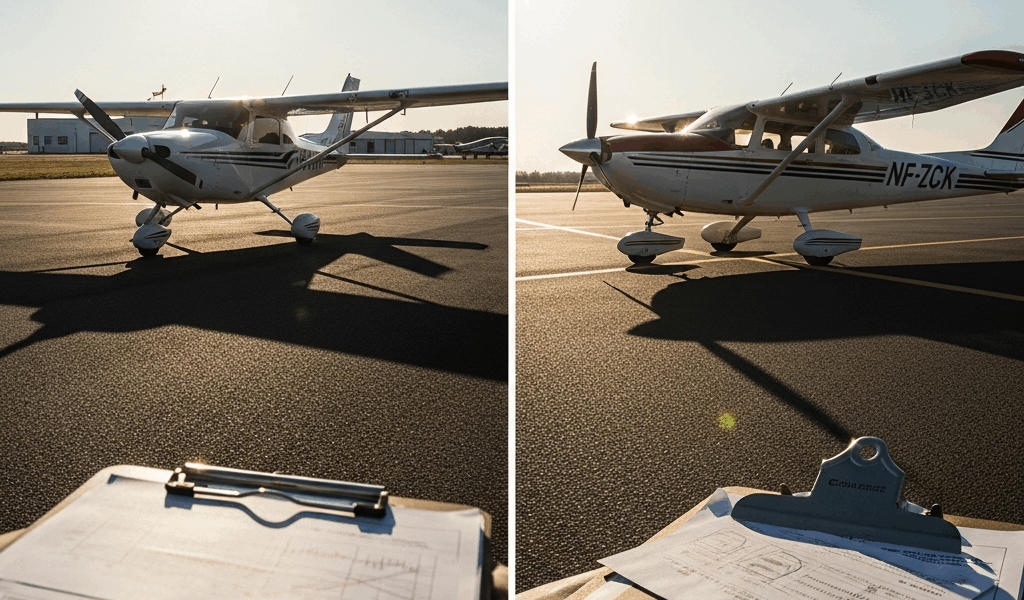
Why Pilots Still Argue About These Two
The Beechcraft Bonanza vs Cessna 182 debate has gotten complicated with all the hot takes and hangar mythology flying around. I’ve sat through enough of these arguments — at fuel stops, at fly-ins, once memorably at an EAA chapter meeting in Oshkosh that ran 45 minutes past its scheduled end — to understand why it never actually gets resolved. These aren’t just two airplanes. They represent two completely different philosophies about what personal flying should look like.
But what is this debate really about? In essence, it’s a question of capability versus accessibility. But it’s much more than that — it’s about who you are as a pilot, what your mission actually looks like on a Tuesday in November, and honestly, what your checking account looks like in March after an unexpected annual.
The Bonanza entered service in 1947 and never really left. The 182 arrived in 1956 and has sold over 23,000 units since. FAA registry data puts active U.S. fleet numbers somewhere around 6,000 to 7,000 Bonanzas and roughly 19,000 Skylanes of various vintages. That fleet depth matters — mechanics know these airplanes, parts exist, and the communities around both are genuinely large. The argument persists not because one airplane is clearly better, but because neither is. Context decides everything. So, without further ado, let’s dive in.
Performance Numbers Side by Side
Pulled from Beechcraft and Cessna POH data and cross-referenced against the AOPA Aircraft Comparison tool, here’s where each airplane actually stands:
- Cruise speed: Bonanza A36 — approximately 174 knots TAS at 8,000 feet. Cessna 182T — approximately 145 knots TAS at 8,000 feet. That 29-knot gap means a 400-nautical-mile leg takes roughly 2.3 hours in the Bonanza versus 2.75 in the 182. On a 45-minute local flight, you’ll never notice it.
- Range: Bonanza A36 — around 860 nm with reserves. Cessna 182T — around 915 nm with reserves, thanks to a more conservative fuel burn profile. The 182 actually edges ahead here on paper.
- Useful load: Bonanza A36 — approximately 1,100 lbs. Cessna 182T — approximately 990 lbs. Neither is a freight hauler, but the Bonanza gives you real flexibility with four adults and bags.
- Service ceiling: Bonanza — 18,500 feet. Cessna 182T — 18,100 feet. Operationally, this is a tie. Neither is a high-altitude specialist without serious oxygen planning.
What the raw numbers miss is feel. The Bonanza demands more pilot engagement during landing — it’s faster on approach, heavier on the controls, less forgiving of a sloppy flare. The 182 lands like it wants to land. That’s not nothing, especially at the end of a five-hour IFR day when your brain is already somewhere on the couch at home. That’s what makes the 182 endearing to us Skylane people, honestly.
Ownership Costs and Maintenance Reality
Probably should have opened with this section, honestly — because this is where most pilots end the comparison early.
Annual inspection costs are genuinely hard to generalize. Talking to IA mechanics at two FBOs I’ve used over the years — one in central Texas, one in western Tennessee — a straightforward annual on a well-maintained 182 runs $1,200 to $1,800 in most markets. A comparable Bonanza annual starts closer to $1,800 and routinely climbs past $3,000 once you factor in retractable gear, a more complex fuel system, and the V-tail variants’ additional control surface inspection requirements. Budget $2,500 per year as a realistic Bonanza baseline. Budget $1,500 for the 182.
Engine overhaul splits these two further. The Continental IO-520 or IO-550 in the Bonanza carries a factory TBO of 1,700 to 2,000 hours and an overhaul cost of $25,000 to $35,000 at reputable shops — Victor Aviation in Salinas or RAM Aircraft in Waco are names you’ll hear repeatedly. The Cessna 182’s Lycoming O-540 has a 2,000-hour TBO and overhauls tend to run $18,000 to $24,000. Amortized over ownership, that gap adds up faster than it looks on a spreadsheet.
Parts availability is strong for both — though Bonanza-specific components, particularly on older V-tail models, carry a premium. Landing gear actuators, for example, are not cheap. Ask me how I know. Insurance is the number that surprises people. A 500-hour private pilot stepping into a Bonanza should expect to pay $3,500 to $5,500 annually for hull and liability coverage on a $200,000 aircraft, based on figures from AOPA’s insurance division. The same pilot in a 182 might pay $1,800 to $2,800. Insurers price recency in type heavily, and the Bonanza’s complex category designation pushes premiums up across the board for lower-time pilots.
The V-tail Bonanza carries an additional reputation burden worth knowing about. Some underwriters price it differently from the straight-tail A36. That matters before you fall in love with the look of a 1968 V35B at an auction and do something you can’t afford to undo.
Safety Record and Incident Data
Frustrated by lazy journalism and recycled accident folklore, a lot of pilots go looking for real data on this — and the actual picture is more nuanced than the V-tail’s reputation suggests.
The V-tail controversy peaked in the 1980s, when NTSB analysis identified a higher in-flight breakup rate compared to other singles. The FAA issued an airworthiness directive in 1987 targeting structural inspections on V-tail models. Critically, many of those incidents involved pre-AD aircraft, pilots flying into convective weather, or airframes with accumulated unreported structural fatigue. When AOPA’s Air Safety Institute looked at accident rates adjusted for fleet hours, the V-tail’s numbers were elevated for that era — but the straight-tail A36 Bonanza sits statistically much closer to average. Two different airplanes, two different risk profiles. Don’t conflate them.
The Cessna 182 has its own incident profile. It appears regularly in NTSB data involving fuel mismanagement — specifically, pilots running tanks dry on long cross-countries. The 182T’s two 46-gallon usable tanks require active management. It also shows up in hard-landing accidents at a frequency worth noting. The forgiving fixed-gear reputation occasionally breeds complacency. That was never a compliment.
Neither airplane is dangerous in competent hands with proper recurrent training. The honest framing: the Bonanza rewards proficiency, and the 182 tolerates the absence of it slightly longer. That’s an operationally meaningful difference — at least if you’re being realistic about how often you actually fly.
Which One Should You Actually Fly
Here’s where I’ll be direct, because “both are great for different reasons” is the kind of conclusion that wastes everyone’s time.
- Building complex time as a PPL or instrument student: The Bonanza wins. There’s no better complex endorsement platform with this much real-world performance. The 182 doesn’t give you that — full stop.
- Weekend cross-country flyer, VFR-primary, 200–400 nm legs: The Bonanza A36 wins again. The speed advantage becomes real above 300 nm. Flying regularly from Dallas to Santa Fe or Nashville to Savannah, the time savings compound fast over a season.
- Instrument currency-focused pilot, single-pilot IFR regularly: The 182 deserves serious consideration here. Lower workload on approach, simpler systems, easier to stay current in. A Garmin GTN 750-equipped 182T is a remarkably capable IFR platform without the cognitive overhead of managing gear and a complex fuel system in hard IMC.
- First-time aircraft owner, 400 to 600 hours total time: Buy the 182. The insurance savings alone — potentially $1,500 to $2,500 per year — fund additional training or a better avionics stack. The ownership learning curve is steep enough without adding a retract and a transition from forgiving to unforgiving on the same weekend.
I’m apparently someone who learned this the hard way — burned once by underestimating transition costs on a complex aircraft early in my flying career, and a humbling conversation with my A&P works for me while ignoring his estimate never did. Don’t make my mistake. The right airplane is the one you can afford to fly often enough to stay sharp in it. A Bonanza you fly 40 hours a year is more dangerous than a 182 you fly 80. Full stop.
For more data-driven comparisons across the high-performance single market, check out the related breakdowns on Piper Cherokee vs Cessna 172 and the PA-28-181 vs 182 cost analysis on this site.




Stay in the loop
Get the latest aviation data updates delivered to your inbox.