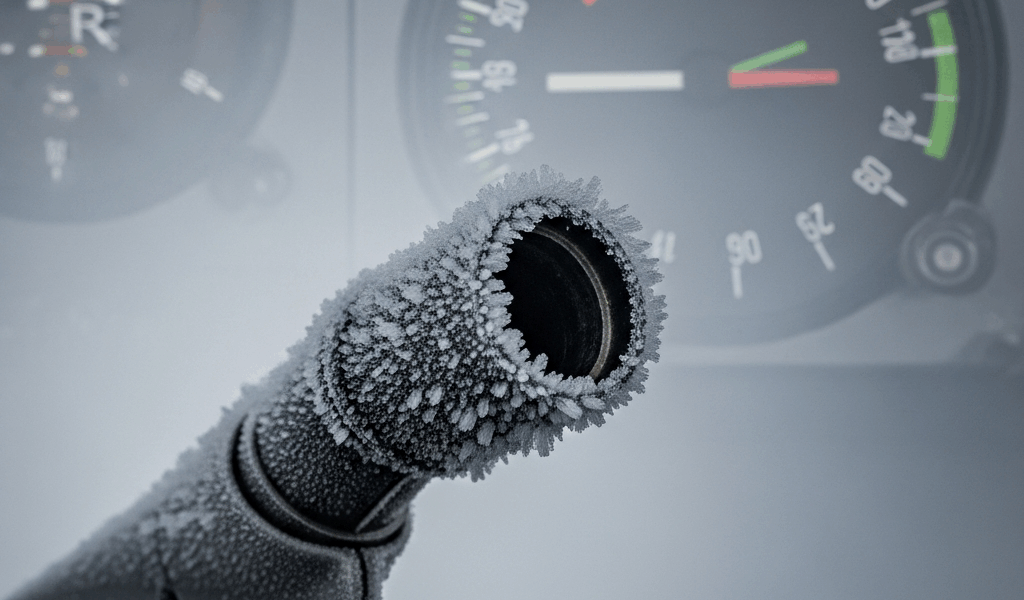
How Pitot Tube Ice Forms and Why Your Airspeed Lies
Pitot tube icing has gotten complicated with all the misinformation flying around — at least among pilots who haven’t experienced it firsthand. I learned about it the hard way during a training flight in a Cessna 172 climbing through visible moisture near 3,000 feet. My airspeed indicator went from a steady 65 knots to 78, dropped to 52, then oscillated wildly for about thirty seconds. That’s when my instructor said: “Your pitot tube is icing. Turn on pitot heat.” Problem solved in seconds. But I didn’t understand why it happened, and that gap in knowledge could’ve been dangerous in actual weather later.
So, without further ado, let’s talk mechanics. Your pitot tube is a small forward-facing probe that measures ram air pressure — the dynamic pressure created by aircraft movement through the air. The static port measures ambient air pressure. Together, they feed an airspeed indicator that calculates the difference. It’s elegant. It also fails catastrophically when ice blocks the pitot opening.
As you climb into visible moisture, supercooled water droplets collide with the pitot’s unheated exterior. Unlike the main fuselage, which has a thin film of warmed air from air friction, the pitot tube — especially in a piston aircraft — remains nearly ambient temperature. Droplets freeze on contact. The ice buildup is fast. Within one minute of continuous icing conditions, you can lose measurable airflow to the pitot.
Here’s what happens next, and honestly, it’s the part most pilots miss: the accumulating ice doesn’t just reduce airflow. It alters the pressure reading entirely. If ice completely blocks the pitot opening, the pressure inside the pitot line becomes static pressure. Your airspeed indicator now reads the difference between static and static, which should be zero. But that’s not what you see. Instead, you get erratic behavior because:
- Partial ice blockage allows intermittent ram air pulses, creating needle flutter that’ll make you dizzy watching it.
- Aircraft pitch and bank changes shift the angle of the ice-roughened pitot surface, changing how pressure is measured at that exact moment.
- Temperature fluctuations can cause ice to sublimate slightly, opening and closing the blockage like a stuck valve.
Supercooled water droplets are the villain here. Between freezing level and roughly −15°C, water can remain liquid despite being below 0°C. These droplets freeze instantly on impact with a cold surface. Above −15°C, ice crystals still form but adhere more slowly — almost leisurely. Below −25°C, you’re mostly dealing with dry snow and ice crystals that bond less aggressively. That’s not comforting — icing is still icing — but the accumulation rate changes. The worst icing usually happens between −3°C and −8°C outside air temperature, right where general aviation aircraft cruise. That was true in 1996, and it’s true now.
Probably should have opened with this section, honestly: a blocked pitot tube creates a false airspeed. It doesn’t read zero. It reads whatever residual pressure exists in the line, and because the static pressure reference is still working, the needle jerks around. One moment you think you’re going 90 knots; the next you’re reading 120. Neither is true. You’re probably at 65 the entire time, and your airplane knows it even if your eyes don’t.
The Six Signs Your Pitot Tube Is Icing Over
Frustrated by erratic instrument behavior, pilots need to recognize what’s actually happening. Symptom one is needle oscillation — your airspeed indicator starts to vibrate or flutter. Not a smooth change. Rapid, erratic movement. This is intermittent ram air pressure getting through the ice blockage, then cutting off as ice re-seals the opening.
Symptom two is a sudden jump to high airspeed. You’re maintaining level flight, but the airspeed indicator climbs 10, 15, sometimes 20 knots above where it was. This happens because the ice-roughened pitot surface is now registering higher stagnation pressure than it should. Your actual airspeed hasn’t changed. The instrument lies.
Symptom three is airspeed dropping while you’re climbing. Counterintuitive, right? In a climb, you expect airspeed to decrease slightly due to pitch attitude and the airplane working harder. But if your airspeed is plummeting while VSI shows a normal climb rate — say, 400 to 500 feet per minute — the pitot is likely icing. The blocked pitot can’t sense ram pressure, so it defaults toward the static reading, which decreases with altitude.
Symptom four is lag worse than normal. Airspeed instruments have some natural lag, especially in older analogs. But if a speed change takes 4 or 5 seconds to register on the needle, and you’re in visible moisture, ice is restricting air passage to the pitot line. Air has to squeeze through ice instead of flowing freely.
Symptom five is disagreement between airspeed and vertical speed indicator. You’re climbing at 500 feet per minute according to the VSI, maintaining what should be 60 knots to stay within climb limits. But the airspeed shows 45. The VSI is measuring static pressure changes — altitude change. The pitot is poisoned. One of these instruments is wrong. Crosscheck wins the argument.
Symptom six is when airspeed and altitude don’t agree in total. You’re level at 5,000 feet, but the altitude has drifted up 200 feet in the last two minutes while you held what you thought was level flight. Airspeed read high the whole time. The pitot lied; you flew a shallow climb without realizing it — probably because you were distracted by the flickering needle.
Pitot Heat vs Alternate Static Source — Which Fixes What
Pitot heat prevents icing inside the pitot tube by warming the probe electrically. Most systems use a heating element rated between 500 and 1,200 watts — roughly the same draw as a household hair dryer. You toggle it on, and within 30 to 60 seconds, heat melts any ice accumulation and keeps new ice from forming. Pitot heat works on the pitot tube only. It does nothing for the static port.
Static port icing is a separate problem entirely. Your static vent can freeze over, blocking the atmospheric pressure reference. When this happens, your altimeter, VSI, and airspeed all go haywire together — they’re all reading wrong because they’re all measuring the same wrong reference. An alternate static source — usually a cabin air source — lets you bypass the external static vent. It’s a manual switch in the cockpit, typically labeled “ALT STATIC” on Cessnas and Pipers. Cabin pressure is slightly higher than outside pressure at altitude, which introduces a small altitude error (maybe 100 to 200 feet), but it’s readable and consistent. That beats wild oscillation.
The decision tree for what to do:
- If airspeed alone jumps, oscillates, or lags: Suspect pitot icing. Turn on pitot heat first.
- If airspeed AND altitude AND VSI are all wrong together: Suspect static port icing. Switch to alternate static source immediately.
- If only altitude is drifting while airspeed and VSI seem okay: Altimeter static leak or blockage. Alternate static may help.
- If you don’t know which is which: Turn on pitot heat first — it’s safer and faster. Then crosscheck against other instruments before making your next move.
Modern pitot tubes in turbine aircraft have redundant pitot systems and automatic heating. In a Cessna 172 with a single heated pitot, you have to detect icing and respond manually. No automation. That’s why the crosscheck matters — your brain is the backup system.
Crosscheck Procedures That Work in Actual Icing
You’re in the clouds at 4,500 feet, climbing toward your cruise altitude. Outside air temperature is −6°C. You see visible moisture starting to form on the windscreen. That’s supercooled water doing its thing. Your airspeed starts to drift upward — slowly at first, then picking up speed.
Step one: acknowledge the discrepancy. Airspeed is now reading 72 knots, but you’re maintaining the same pitch and power you were two minutes ago. Something changed. It wasn’t your hand on the yoke.
Step two: cross-check against VSI. The vertical speed indicator is showing a steady 300 feet per minute climb. That rate hasn’t changed. Your actual airspeed should be consistent with that climb rate at this power setting. The VSI is reliable because it’s measuring static pressure change with altitude. The VSI hasn’t lied to you yet.
Step three: check outside air temperature. Look at the OAT gauge on your panel. −6°C is prime icing conditions. You’re in the zone where supercooled water droplets thrive.
Step four: turn on pitot heat. Toggle the switch. Most systems have a light that illuminates when the heater is active — that small amber light in your lower left panel. You’ll see it glow.
Step five: lean forward and listen. You’ll often hear a faint ticking or clicking sound inside the pitot heat circuit — this is normal operation. Some aircraft have an ammeter spike when you activate pitot heat. You’re drawing 10 to 15 amps from the electrical system. That’s expected and it’ll show on your electrical system monitor if you have one.
Step six: wait 30 to 60 seconds. Don’t rush. Ice takes time to melt, and forcing the situation doesn’t help.
Step seven: re-cross-check. Is airspeed now steady? Does it agree with VSI and power setting? If yes, icing is solved and you can breathe again. If airspeed is still erratic, check two things: is pitot heat actually working (light still on, ammeter showing draw), and are you still in visible moisture? If you’re still icing and pitot heat is on, you have a pitot heat malfunction or you’re in severe icing. Exit the conditions immediately — descend or turn back.
What if pitot heat was already on when the problem started? Then you have a system failure, likely a pitot tube blockage from a previous flight or a heat element malfunction. Trust the VSI and altitude. Abandon the pitot airspeed reading entirely. Fly by power setting and VSI if necessary — it’s not ideal, but it’s safer than chasing a false airspeed needle.
When Pitot Tube Icing Gets You Into Real Trouble
Colgan Air Flight 3407 crashed into a home near Buffalo, New York, in February 2009. Icing was part of the chain reaction. The Bombardier Q400 turboprop — a 76-seat regional turbine — encountered visible moisture and moderate icing. The pitot probes iced over. The flight crew received unreliable airspeed indications. Instead of cross-checking against other instruments and the flight envelope, the first officer over-corrected by pulling back on the yoke hard. The airplane stalled. High altitude, no recovery time. Fifty people died.
The National Transportation Safety Board found that the crew did not recognize the unreliable airspeed condition. They didn’t crosscheck the VSI, altitude, or flight path against what the pitot was telling them. One instrument, trusted absolutely, killed them.
Icing plus poor instrument discipline equals spatial disorientation and loss of control. You can’t see the horizon in cloud. You can’t feel the airplane’s attitude through the seat. Instruments are your only reference. But instruments can lie — that’s the problem nobody wants to admit. Instruments together tell the truth, though. Three independent sources agree. One goes nuts. Problem solved, assuming you’re paying attention.
Trust one. Die fast. Three instruments survive. It really is that simple.


Stay in the loop
Get the latest aviation data updates delivered to your inbox.