How Many Times Has CAPS Actually Been Pulled
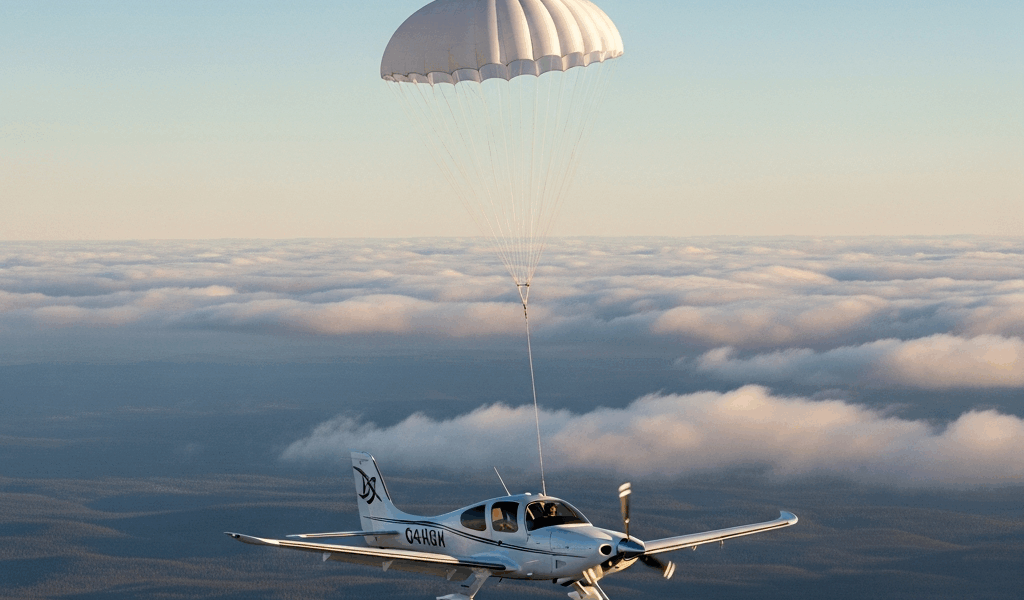
The Cirrus SR22 parachute system has gotten complicated with all the myths and half-truths flying around. So let me cut straight to what the numbers actually show — because the numbers are the only thing worth arguing about here.
Through 2023, Cirrus Aircraft logged over 650 whole-airplane parachute deployments across the SR20 and SR22 fleet. That’s since 1999. Over two decades of real-world data, not simulator runs or manufacturer projections. Real emergencies. Real pilots. Real outcomes.
With roughly 4,000 SR22s in the air logging approximately 1.2 million hours annually, you’re looking at an activation rate somewhere around 1 per 6,000 to 8,000 flight hours. Most of those cluster early — first few hundred hours of ownership, when pilots are still getting comfortable with the avionics and their own confidence gaps. New airplane. New glass. Unfamiliar feel. That’s when things go sideways.
Of those 650-plus deployments, approximately 94 percent resulted in occupant survival. That’s the number that matters. Sit with it for a second.
NTSB data tells a harder story on the other side. Between 2005 and 2022, roughly 40 fatal SR22 accidents occurred in scenarios where CAPS deployment was feasible — and wasn’t used. Compare that to the low single-digit fatality count in actual deployments. The gap is not subtle. The deployment scenarios break down roughly like this: engine failure accounts for around 35 percent, loss of control or spatial disorientation in instrument conditions runs about 28 percent, and structural concerns, medical incapacitation, and system malfunctions split whatever’s left.
What the Data Says About Survival Rates
Probably should have opened with this section, honestly.
Pulled in the final seconds before something catastrophic, CAPS doesn’t give pilots time to deliberate. The survival data reflects exactly that kind of compressed, ugly decision window. Of 650 deployments, roughly 614 resulted in survival. That’s not the same as zero injuries — spinal compression shows up in about 12 percent of cases, because the chute opens hard and occupants absorb sustained G-loading. Broken legs. Fractured ribs. Soft tissue damage. But those people are alive. They’re in an ER, not a body bag. That distinction is everything.
NTSB reports on fatal SR22 accidents without CAPS tell a different story entirely. An engine failure at 2,000 feet or below, with a pilot committed to flying it into a field — the impact forces at 80 to 120 knots crush aluminum structure and end lives. There’s no seat that absorbs that. The SR22’s overall safety record sits at 0.57 accidents per 100,000 hours when CAPS deployments are included in the denominator. That’s roughly one-fifth the rate of comparable singles without a parachute system. One-fifth.
Two cases illustrate what those numbers actually look like in practice. In 2019, an SR22 pilot over the Sierra Nevada hit unexpected icing at 8,500 feet. Engine performance dropped. Instead of attempting a spiral descent through the clouds, the pilot pulled CAPS at 6,200 feet. The chute deployed cleanly. The aircraft came down in a stable, controlled descent. Both occupants walked away — spinal strain and one broken wrist between them. The NTSB report credited CAPS directly with survival.
Then there’s 2017. SR22, engine failure at 1,800 feet over rough terrain. The pilot didn’t pull. He went for a forced landing on a mountainside. The aircraft struck terrain at high speed. Both occupants died on impact — injuries consistent with sustained high-impact deceleration, per the coroner’s report. Same airplane. Different choice. Different outcome.
The trend isn’t subtle. CAPS deployment correlates with survival. Non-deployment in comparable scenarios correlates with fatality. It’s not a guarantee — altitude, terrain, and landing zone characteristics all affect how things end. But the direction of the data is unmistakable.
The Scenarios That Trigger Activation
Engine failure below 3,000 feet is its own kind of brutal math. At 2,500 feet in an SR22, single occupant, you have maybe 90 to 120 seconds before impact if you commit to gliding. That’s not enough time to find a suitable field, assess the wind, configure the airplane, and execute a landing cleanly. Pulling CAPS at 2,200 feet gives you roughly 1,200 feet of descent at minimal forward speed. Survivable — where the forced landing often isn’t.
Loss of control in instrument meteorological conditions accounts for a surprisingly large share of deployments. A pilot hits unexpected wind shear. Gets disoriented in clouds. Loses spatial reference entirely. The SR22 isn’t immune to any of that — what it offers is an eject button. At 4,000 feet, spiraling uncontrollably in IMC, pulling CAPS stops the spiral and converts an unrecoverable situation into a controlled descent. That’s what makes the system endearing to us SR22 pilots — it reframes “unrecoverable” into something survivable.
Structural concerns trigger maybe 8 to 10 percent of deployments. Unusual vibration. Control surface flutter. Suspected hail damage to the fuselage. These pilots don’t fully trust the airframe anymore, and they’re right not to. Safer to land under a parachute at 200 feet per minute than risk structural failure at 10,000 feet over terrain with no good options below.
Medical incapacitation in the left seat is its own category. In a handful of documented cases, a conscious right-seat passenger — no pilot certificate, no training — pulled CAPS instead of attempting to land the airplane manually. Both survived. The alternative scenario, an untrained person trying to dead-stick an SR22 into a runway, is almost certainly fatal. CAPS gave them a way out that didn’t require knowing how to fly.
The minimum altitude envelope gets misunderstood constantly. CAPS needs roughly 400 feet to deploy and orient before landing — below that, the chute may not fully open, or may not slow the aircraft enough. Above 15,000 feet it works fine, but descent rate and drift increase meaningfully. The practical sweet spot is 800 to 14,000 feet. Within that band, the system is reliable. Outside it, outcomes get harder to predict.
Why Pilots Wait Too Long to Pull
The psychology here matters as much as the mechanics — because the data reveals a pattern that keeps repeating in NTSB reports. Pilots wait. They wait longer than the altitude allows. And it kills them.
Sunk cost bias is part of it. An SR22 runs somewhere north of $700,000 new — and used ones aren’t cheap either. You’ve spent months building proficiency. Hundreds of hours. Real money and real effort. When something goes wrong, the instinct says: save the airplane. That’s not irrational. It’s human. But an engine failure at 1,200 feet becomes unrecoverable not because CAPS wasn’t available — it’s because the pilot spent 45 seconds trying to restart the engine and locate a field while altitude evaporated below the minimum deployment window. Don’t make that mistake.
Training bias reinforces it. Decades of single-engine training build one core message into pilots: fly the airplane. Forced landing procedures dominate the curriculum. CAPS gets treated as a last-resort backup rather than a first-line safety tool. Pilots have invested in one cognitive framework, and under stress, they default to it. NTSB investigators note this pattern specifically — opportunities for CAPS deployment that pilots recognized too late or not at all.
The repack cost adds another layer of hesitation. A CAPS deployment triggers mandatory inspection and repack — around $15,000 to $20,000 depending on who does the work. Real money. Early deployment at a comfortable altitude over a good landing zone can feel wasteful, almost embarrassing. But I’m apparently the kind of person who’d rather explain a $17,000 repack bill than not be around to pay it — and that framing works for me while second-guessing the handle never does.
Accident investigations show the same pattern repeatedly. Pilots waiting for certainty. Waiting to confirm the engine failure is real and not a fuel selector issue. Waiting to find a field. Waiting to finish troubleshooting. In case after case, waiting cost them their altitude — and then their lives. In cases where pilots pulled earlier, sometimes even prematurely, they lived. Uncomfortable trade-off. Clear outcome.
What SR22 Pilots Should Take Away From the Numbers
So, without further ado, let’s get to what actually matters practically — because the data is only useful if it changes how you fly.
First, you should know your minimum decision altitude before you need it — at least if you fly over anything other than flat farmland. Mountains push that number up. Water pushes it up further. Pre-calculate it for the routes you actually fly. Write the number down on your kneeboard. Refer to it. Your in-flight brain under stress is not the right tool for calculating this on the fly.
Second, practice the decision scenario mentally. Not pulling the handle — you can’t rehearse that safely. But running through the logic before you’re stressed is entirely possible. Engine failure at pattern altitude. Spatial disorientation in clouds. Structural concern you can’t identify. Walk through the trigger conditions during your preflight, not your emergency. Your brain will access those pathways faster when the situation is real and your hands are already moving.
Third — and this one matters more than it sounds — reframe CAPS as a tool rather than an admission of failure. It’s not what you reach for when you’ve failed to fly the airplane properly. It’s what you reach for when the airplane has failed you. That’s a different thing entirely. That distinction changes how fast your hand moves toward the handle when it counts.
CAPS deployment kills your airplane but saves your life. Every SR22 pilot should know that trade is worth making — and know it before the moment arrives. The system gives you that choice. The numbers say: use it sooner, not later, when genuine emergency conditions develop. That’s what the 650-plus deployments, the 94 percent survival rate, and the 40 fatal non-deployments are all trying to tell you.


Stay in the loop
Get the latest aviation data updates delivered to your inbox.