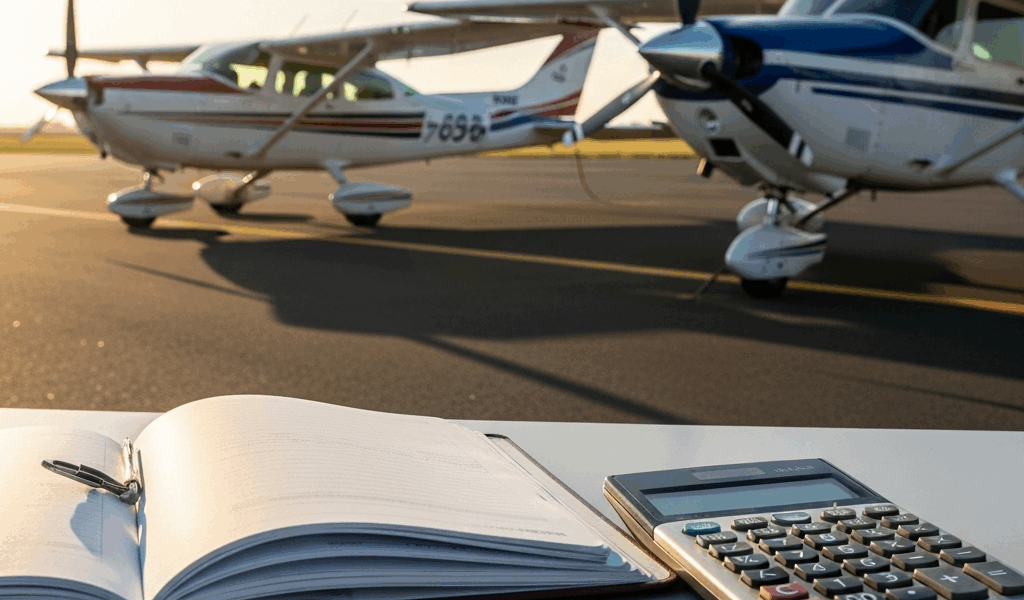
Cessna 172 vs Piper Cherokee — Which One to Train In
Why These Two Still Dominate Flight Training
Flight training has gotten complicated with all the aircraft options, opinions, and YouTube rabbit holes flying around.
The Cessna 172 vs Piper Cherokee argument is probably the first real disagreement student pilots have — usually in a flight school waiting room, nervously watching someone else nail a crosswind landing. I’ve been in that waiting room. I’ve had that argument. And here’s the thing: these aircraft aren’t interchangeable. The right choice genuinely depends on where you’re headed after you earn your certificate.
The numbers are worth knowing upfront. The FAA registry consistently shows the Cessna 172 as the single most registered aircraft type in the United States — over 21,000 registered airframes as of recent pulls. The PA-28 family trails but still represents one of the largest single-type populations in general aviation, somewhere between 14,000 and 16,000 registered across Cherokee, Warrior, and Archer variants. No other trainer comes close at scale. That gap matters, because fleet size drives availability, availability drives training pace, and training pace drives your total cost. But availability alone doesn’t make the 172 the right call for everyone. So, without further ado, let’s dive in.
Handling and Flight Characteristics Compared
The most obvious difference between these two has nothing to do with horsepower or avionics. It’s the wing. High wing on the 172, low wing on the Cherokee. That single design decision creates a fundamentally different flying experience — from pattern entry all the way through the flare on short-field approaches.
Visibility and Traffic Awareness
In a 172, scanning traffic above you is effortless. You can also see the ground clearly during turns without craning your neck at odd angles. In a Cherokee, you lift the wing to clear turns before maneuvering — it becomes second nature fast, but early students have to build that habit in consciously. Extra mental load at exactly the wrong time.
That said, the Cherokee gives you a cleaner instrument scan inside the cockpit. Less light flooding the panel from above. Pilots transitioning to IFR consistently say they felt more at home in the Cherokee’s cockpit environment. That’s what makes the Cherokee endearing to pilots who know they’re heading toward instrument work.
Control Feel and Crosswind Behavior
The Cherokee has heavier control forces. Full stop. The ailerons require more deliberate input — some instructors argue this builds better muscle memory for coordinated flight. Maybe. But the 172’s lighter, more responsive controls are genuinely more forgiving when a student is still developing their scan and their feet haven’t figured out the rudder yet.
Crosswinds are where this diverges most sharply. The 172’s high wing creates more weathervaning tendency in gusty conditions, but lighter controls mean corrections happen quickly. The Cherokee sits lower to the ground and is more stable in crosswinds — some students find the flare less intimidating because of it. Both aircraft handle normal crosswind limits without drama. The 172 is more forgiving for early students. That’s not just an opinion. Time-to-solo averages back it up.
Real Training Costs and Fleet Availability
Probably should have opened with this section, honestly. Because for most student pilots, cost isn’t a footnote — it’s the entire conversation.
Wet Rental Rates
Across US flight schools surveyed through 2023 and into 2024, Cessna 172 wet rental rates typically run $155 to $200 per hour for older steam-gauge aircraft. Newer 172S models with Garmin G1000 NXi glass panels commonly rent between $185 and $230 per hour. Piper Warriors and Cherokees — the PA-28-161 and PA-28-180 being the most common training variants — rent for $140 to $185 per hour at most Part 61 and Part 141 schools. The Cherokee is usually $20 to $40 cheaper per hour.
Over a private pilot certificate requiring 60 to 70 hours of total flight time for the average student, that difference adds up to $1,200 to $2,800 in real savings. That’s not nothing. Don’t make my mistake of ignoring the math early on.
Parts, Maintenance, and Downtime
Here’s where the Cherokee holds an edge that doesn’t get talked about enough. Piper PA-28 parts have historically been cheaper and more available through the aftermarket than comparable Cessna components. Owners on forums like Beechtalk and the Piper Owner Society consistently report lower annual inspection costs for PA-28s in similar condition. One A&P mechanic I spoke with at a regional maintenance facility in the Southeast estimated their PA-28 Warriors averaged roughly 15 to 20 percent lower annual maintenance costs than the comparable 172s sitting in the same hangar.
But — and this matters — the 172’s sheer volume in the fleet means if a part is needed, someone nearby probably has it. Textron Aviation’s continued 172 production keeps newer components flowing. The Cherokee’s advantage is per-unit cost. The 172’s advantage is speed of maintenance resolution and getting the aircraft back in the air. For a school with six 172s, one going down barely disrupts the schedule. One Cherokee down at a three-plane school? Students are waiting.
Time to Solo
Average time to first solo hovers around 12 to 15 hours across both platforms when a student is flying two or three times per week. Instructors anecdotally report slightly faster progression in the 172 for students with zero prior aviation background — lighter controls and better ground visibility seem to be the main factors. Students who come in with simulation time or prior complex vehicle experience tend to transition equally well to either aircraft. I’m apparently someone who fell into the second category, and the Cherokee worked for me while the extra visual adjustment in the 172 never really slowed me down either. Your results will vary.
Which Aircraft Prepares You Better for What Comes Next
But what is the low-wing transition, really? In essence, it’s the process of relearning visual references, fuel management habits, and cockpit discipline when moving from a high-wing aircraft to a low-wing one. But it’s much more than that — it’s hours of adjusted muscle memory built at a point in training when you’d rather be focused on something else entirely.
The vast majority of complex singles used in commercial and instrument training are low-wing. The Piper Arrow PA-28R-201. The Beechcraft Bonanza A36. The Mooney M20J. Train in a 172, then step up to a Piper Arrow for commercial training, and you’re suddenly adjusting to new sight pictures on final, different fuel management requirements — no more gravity-feed simplicity — and a flare that feels nothing like what you’ve been doing for 70 hours. Manageable. Not a crisis. But real time spent re-learning instead of building forward.
Students who train in the Cherokee start building low-wing habits from day one. The instrument scan, fuel management discipline, the visual picture on final — all of it transfers directly to the PA-28R Arrow, which remains the most common complex single used for commercial certificate training at Part 141 schools. Frustrated by having to re-learn basic visual references mid-instrument training, many pilots later wish they’d started low-wing and never looked back. This new habit-building efficiency took root in training programs several years ago and eventually evolved into the low-wing-first philosophy many serious flight schools now push today.
For IFR specifically, the Cherokee’s darker, more controlled cockpit environment and heavier control forces are legitimately solid preparation for flying partial panel or under the hood. The 172 is not a bad IFR trainer — not even close. But the Cherokee builds habits that don’t need to be unlearned when you start flying approaches in IMC.
The Verdict — Pick the One That Fits Your Path
While you won’t need to choose between a $500,000 turboprop and a two-seat ultralight, you will need a handful of honest answers about where your training is actually headed. First, you should figure out whether a private certificate is the finish line or just the starting gate — at least if you want to make a smart decision here.
Zero flight experience and a private pilot certificate is your only current goal? Train in the Cessna 172. More available, slightly more forgiving in the early hours, and the higher fleet density means your training won’t stall because the aircraft is down for an unscheduled annual. The 172 might be the best option, as early training requires consistency above all else. That is because inconsistent flying intervals are the single biggest driver of extended training timelines and inflated final costs.
Already know you’re pursuing an instrument rating, commercial certificate, or any kind of professional pathway? Start in a Piper Cherokee or Warrior. The low-wing transition costs you nothing when you’re starting fresh, and you’ll build cockpit discipline that pays dividends the moment you start flying approaches in IMC or climbing into a complex aircraft for the first time. That was the right call then. It’s still the right call now.
Whichever airplane you choose, a headset or home simulator should be treated as supplemental practice unless the complete device and use are authorized. See the VR pilot-training and FAA credit guide before paying for claimed loggable simulator time.

Stay in the loop
Get the latest aviation data updates delivered to your inbox.