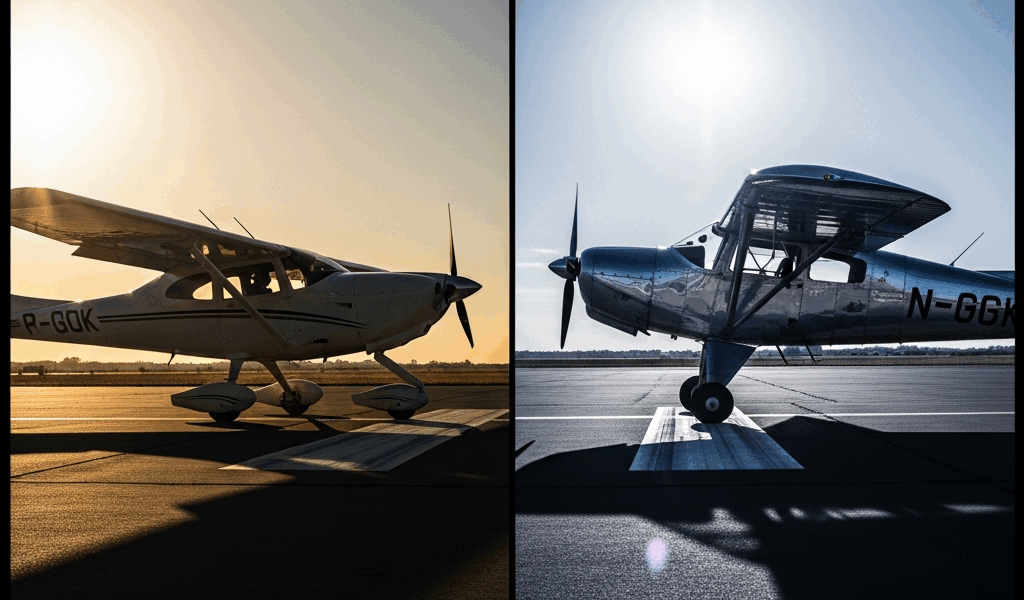
SR22 vs Piper Archer — The Core Difference in One Sentence
The SR22 vs Piper Archer debate has gotten complicated with all the forum noise flying around. Everyone’s got an opinion. Almost nobody leads with the actual numbers. So here it is straight: the SR22 is a fast, composite, cross-country machine with a ballistic parachute bolted to the airframe, and the Archer is a forgiving, fixed-gear metal airplane descended directly from the PA-28 Cherokee trainer. That lineage matters more than most people admit. This article is written for pilots making a real decision — personal ownership, renter-to-owner transition, flight school fleet evaluation. Not airline track. The actual choice between two very different machines.
I’ve talked to pilots who bought an SR22 at 180 hours and spent the next year fighting insurance underwriters and their own skill ceiling. That pattern is completely avoidable. The data makes it obvious — if you know where to look. Today, I’ll share it all with you.
Performance Numbers Side by Side
Pulled directly from the Cirrus SR22 G6 POH and the Piper Archer TX PA-28-181 POH. No editorializing. Just what the aircraft actually do:
| Metric | Cirrus SR22 (G6) | Piper Archer TX |
|---|---|---|
| Cruise Speed (KTAS) | 183 KTAS | 128 KTAS |
| Fuel Burn at 75% Power | ~16.0 GPH | ~10.0 GPH |
| Range (with reserves) | ~950 NM | ~520 NM |
| Useful Load | ~1,094 lbs | ~907 lbs |
| Service Ceiling | 17,500 ft | 14,100 ft |
| Sea-Level Climb Rate | 1,270 FPM | 735 FPM |
The SR22 wins on nearly every performance line. That 55-knot cruise advantage isn’t a rounding error — on a 500-nautical-mile trip, you’re on the ground nearly 25 minutes earlier. The useful load gap matters the moment you’re flying four people with actual luggage. And 17,500 feet of service ceiling means real weather avoidance options the Archer simply cannot reach.
The Archer wins on fuel burn. Ten GPH versus sixteen is real money — not theoretical money. At $6.50 per gallon, which is honestly optimistic at most FBOs right now, that’s $39 per hour for the Archer versus $104 for the SR22. Over 100 hours annually, that gap is $6,500. Per year. Just in fuel.
The Archer also wins on mechanical simplicity. Fixed pitch prop option, fixed gear, no turbo on the naturally aspirated version. Fewer things to brief, fewer things to break, fewer things that bite you during a high-workload moment when your scan falls apart.
Ownership Costs — What You Actually Pay Per Year
Probably should have opened with this section, honestly. Performance specs seduce people. Costs wake them up.
Insurance
For a pilot under 500 hours total time with an instrument rating, SR22 hull insurance on a 2018 model — valued around $480,000 — runs $8,000 to $14,000 annually. Sometimes higher, depending on make/model time and recent checkride history. Underwriters treat the SR22 as high-performance complex and price accordingly. They’re not wrong.
The Archer at under 500 hours? Expect $1,800 to $3,500 annually for a 2010 PA-28-181 valued around $185,000. That’s not a minor difference. For a 300-hour pilot, SR22 insurance alone can exceed the Archer’s entire annual operating budget. Many underwriters won’t quote SR22 coverage without a CSIP-documented transition course already on record — so add that to your first-year math.
Annual Inspection
Archer annuals at a competent shop run $1,200 to $2,500 for a clean aircraft with no squawks. SR22 annuals — composite structure, CAPS system inspection, Avidyne or Perspective+ avionics suite — run $2,500 to $5,500. Higher if the parachute rocket motor is due for replacement. That interval arrives roughly every ten years and costs approximately $8,000 to $12,000 when it does. Budget for it before it surprises you.
Engine Reserve
The SR22’s Continental IO-550-N carries a 2,000-hour TBO and overhaul costs around $40,000 to $50,000. Reserve $20 to $25 per hour. The Lycoming O-360 in the Archer — same 2,000-hour TBO — overhauls for $18,000 to $24,000. Reserve $9 to $12 per hour. The gap compounds over time in ways that sneak up on owners who don’t track reserves obsessively.
Hangar
Comparable for both. T-hangars run $350 to $700 monthly depending on your airport — the SR22’s 38-foot wingspan is slightly wider than the Archer’s 35 feet, which is worth confirming with your airport manager before signing anything. Don’t make my mistake and assume a T-hangar fits both aircraft identically.
The fixed-cost reality check: an SR22 owner flying 100 hours annually should budget $28,000 to $42,000 per year before fuel. An Archer owner at the same utilization runs $12,000 to $18,000. The SR22 costs more than twice as much to own — not to fly faster. To own.
Training Path and Transition Complexity
Stunned by how often this section gets skipped in aircraft comparison content. The training requirement difference between these two is significant, and it directly hits your first-year cost in ways nobody warns you about.
The Piper Archer is fixed gear, offers a fixed-pitch prop option, requires no complex endorsement, and flies predictably close to what most pilots trained on during primary. Transitioning into an Archer from a Cessna 172 or PA-28-161 Warrior takes most pilots two to five hours with a CFI. That’s it. Legal and current.
The SR22 is a different story entirely. Cirrus requires — and insurance underwriters demand — a CSIP transition course before solo flight. The factory-approved CSIP course runs approximately $2,500 to $4,500 depending on location and ground school format. Beyond cost, the aircraft requires both a complex and high-performance endorsement. The Garmin Perspective+ or Avidyne Entegra glass cockpit, combined with CAPS training, creates a steep initial workload that genuinely catches people off guard.
Pilots under 200 hours should treat the Archer’s accessibility as a feature, not a consolation prize. A forgiving airframe that doesn’t require specialized instruction builds foundational stick-and-rudder skills faster and cheaper. Pilots above 500 hours — instrument current, recent complex time, cross-country-focused mission profile — will absorb the SR22 transition more naturally and actually use what the aircraft offers. That’s what makes the Archer endearing to low-time pilots who are honest with themselves about where they are.
CAPS — the Cirrus Airframe Parachute System — changes the training philosophy in ways worth acknowledging. It is a genuine life-saving system. Nineteen documented saves as of recent reporting. Insurance underwriters know this, pilots know this, and it shapes how Cirrus trains pilots to respond to emergencies. That’s not a criticism. It’s a context shift. Some CFIs argue it creates a different risk calculus than traditional aeronautical decision-making teaches — and that argument isn’t entirely wrong.
Which One Should You Choose — A Decision Framework
But what is the right framework here? In essence, it’s matching aircraft capability to pilot experience and mission reality. But it’s much more than that. So, without further ado, let’s dive in.
Choose the Piper Archer if
- You have fewer than 300 total hours
- Your annual flying budget sits under $25,000 all-in
- Your primary missions are local flying, VFR cross-countries under 400 NM, and proficiency building
- You’re a flight school operator prioritizing low maintenance cost and student-tolerant handling
- You want resale flexibility — hundreds of Archers on the market with buyers at every price point
Choose the SR22 if
- You have 500 or more hours with instrument currency and recent complex time
- Your missions regularly exceed 400 NM with passengers and bags
- You can budget $35,000 or more annually for ownership costs without flinching
- Speed is a genuine operational requirement — not just a preference
- You want strong resale value — SR22s hold it better than almost any other piston single on the market
On that last point: a 2015 SR22 G5 that sold new for $485,000 trades today in the $380,000 to $420,000 range depending on hours and avionics. A 2015 Archer TX that sold new around $280,000 trades in the $185,000 to $210,000 range. The SR22 depreciates more slowly in absolute dollar terms — worth knowing if you’re treating this as a long-term asset rather than a pure expense.
I’m apparently a stick-and-rudder obsessive, and the Archer works for me in ways the SR22 never quite did on those early cross-countries. I flew the Archer first — maybe 200 hours in PA-28-181s — then got left seat time in a friend’s SR22 G3 for a few longer trips. The thing nobody tells you: the Archer is genuinely fun to fly in a way that makes you better. The SR22 is impressive in a way that makes you feel like you’re managing a system. Both things are true. Both aircraft are good. The numbers just make it clear which one belongs in which pilot’s hangar at which point in their career.
Every aircraft decision should start with data, not forum posts. That’s the whole premise here.


Stay in the loop
Get the latest aviation data updates delivered to your inbox.