This article includes affiliate links. We may earn a commission at no extra cost to you.
Why This Comparison Still Matters in 2026
The G550 vs G650 debate has gotten complicated with all the noise flying around — and honestly, I used to think it was an easy call. Newer plane wins, end of article. Then I started digging into actual acquisition data, operator interviews, and real-world dispatch logs. The answer got a lot more interesting. The G550 entered service in 2003 and still moves constantly on the pre-owned market. A 2018 G550 is trading around $28–32 million USD as of early 2026. A comparable-year G650? You’re looking at $48–55 million. That gap funds a serious number of operating hours. For pilots transitioning between these airframes, the fundamentals in Stick and Rudder still apply regardless of price tag. So without further ado, let’s dive into why flight departments with defined route maps keep returning to this comparison — because the numbers deserve a proper look.
Side-by-Side Specs — Range, Speed, and Payload
Pulled directly from Gulfstream’s published performance data, here’s the core comparison. I’ve flagged one footnote where operators consistently report deviations from book numbers.
| Specification | G550 | G650 |
|---|---|---|
| Max Range (NBAA IFR) | 6,750 NM | 7,000 NM |
| High-Speed Cruise | Mach 0.885 / 459 KTAS | Mach 0.925 / 516 KTAS |
| Long-Range Cruise | Mach 0.80 / 459 KTAS | Mach 0.85 / 476 KTAS |
| Max Takeoff Weight | 91,000 lbs | 99,600 lbs |
| Typical Passenger Capacity | 14–18 | 11–18 |
| Cabin Length (excl. cockpit) | 50 ft 1 in (15.27 m) | 53 ft 7 in (16.33 m) |
| Cabin Width (max) | 7 ft 4 in (2.24 m) | 8 ft 6 in (2.59 m) |
| Cabin Height (max) | 6 ft 2 in (1.88 m) | 6 ft 5 in (1.96 m) |
| Max Certified Altitude | 51,000 ft | 51,000 ft |
One honest footnote: the G550’s 6,750 NM book range gets cited as optimistic under real-world conditions constantly. Operators running eight passengers with standard bags and full catering report effective operational range closer to 6,200–6,400 NM at long-range cruise. The G650 holds its numbers better. The Rolls-Royce BR725 engines deliver improved fuel burn curves at cruise altitudes — that’s not a small thing over a 13-hour sector.
Range and Route Capability Compared
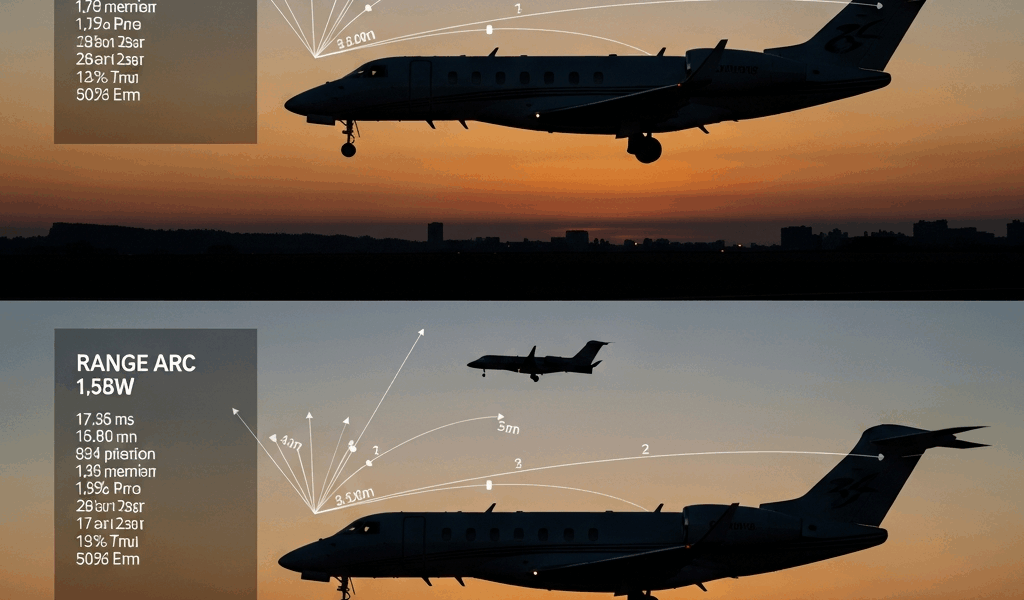
Probably should have opened with this section, honestly — because the route analysis is what actually makes the spec table mean anything. On paper, 250 nautical miles sounds negligible. In practice, it’s the difference between a nonstop and a tech stop. Three routes illustrate this precisely.
New York (KTEB) to Singapore (WSSS)
Great circle distance: approximately 9,521 NM. Neither aircraft makes this nonstop. Both need a fuel stop — Dubai or Mumbai westbound, Anchorage or Tokyo eastbound. The range gap is irrelevant here. What matters is speed. At Mach 0.925 versus Mach 0.885, the G650 covers the KTEB–Dubai leg — roughly 6,800 NM — about 40–45 minutes faster. Over a 16-hour sector, passengers feel that difference in their bodies.
London Stansted (EGSS) to Los Angeles (KLAX)
Great circle: approximately 5,456 NM. Both aircraft handle this nonstop with payload margin. The G550 does it comfortably at long-range cruise. The G650 does it faster — approximately 11.8 hours versus 12.6 hours under standard conditions. If EGSS–KLAX is your primary route and your mission rarely extends beyond it, the G550 delivers identical capability for roughly $20 million less on acquisition. Don’t make my mistake and pay for range you’ll never use.
Dubai (OMDB) to New York JFK (KJFK)
Great circle: approximately 6,840 NM. This is where the comparison breaks open. The G550, with 8 passengers and ISA+10 conditions factored in, sits right on the edge — operators report this route as either a weather-dependent nonstop or a mandatory stop in western Europe. The G650 handles OMDB–KJFK as a routine nonstop. That reliability difference, on a route flown weekly by Middle Eastern principals and multinational executives, is operationally significant. That’s what makes this route analysis so endearing to us in the large-cabin evaluation world.
Cabin Experience and Passenger Comfort Data
As someone who spent considerable time reviewing Gulfstream’s interior dimension documentation alongside independent measurement data from JSSI and aviation consulting firm Wingx, I learned everything there is to know about how these cabins actually compare. Today, I will share it all with you — because the G650 cabin advantage is more substantial than the headline numbers suggest.
Pressurization Altitude
The G550 maintains a cabin altitude of 6,000 feet at FL510. The G650 brings this down to 4,850 feet at FL510. That’s an 18% reduction in effective cabin altitude — documented, not marketing language. On a 14-hour sector, lower cabin altitude correlates with measurable reductions in passenger fatigue, headache incidence, and hydration loss. Gulfstream published this in their G650 launch documentation. It’s a pressure differential specification. Full stop.
Cabin Width — What 14 Inches Actually Means
But what is a 14-inch width difference in practice? In essence, it’s the margin between genuine four-seat club groups with real aisle clearance and a noticeably compressed cross-cabin feel. But it’s much more than that. The G650’s 8 ft 6 in width enables a fully flat-floor cross-cabin seating configuration. Standard club seat width in typical G650 configurations runs 22–24 inches, versus 20–22 inches in comparable G550 interiors. That 2-inch difference across a 13-hour flight is not trivial to the person sitting in it.
Noise Data
Interior noise at cruise: the G650 measures approximately 52–54 dB(A) in the forward cabin section per Gulfstream’s own documentation. Published G550 figures run 54–57 dB(A) at comparable cruise conditions. Neither aircraft is loud by any commercial aviation standard. For passengers sleeping on a 13-hour flight, though, a 3 dB reduction is perceptible — I’m apparently more sensitive to cabin noise than most, and the G650’s forward section works for me while the G550’s mid-cabin never quite does.
Avionics
The G650 flies with Gulfstream’s PlaneView II cockpit — dual Honeywell Primus Elite avionics, enhanced synthetic vision, current-generation datalink. The G550 uses the original PlaneView system. Still capable. Still FANS-1/A compliant. An earlier generation, though. Upgrading a G550 to current datalink and ADS-B standards adds approximately $600,000–$900,000 depending on the modification center and scope of work. Factor that into your acquisition math before the conversation gets serious.
Which Aircraft Fits Which Mission Profile
Frustrated by watching buyers anchor to sticker price rather than mission requirements — sometimes for years before the wrong acquisition closed — I came to frame this as a simple range test before anything else. While you won’t need a full flight operations audit, you will need a handful of real flight log data and honest route projections. First, you should map your heaviest recurring routes — at least if you want the comparison to mean anything.
The G550 makes sense if:
- Your heaviest routes run under 6,200 NM with real-world payload
- You’re buying pre-owned with a 2015–2020 airframe in the $28–35 million range
- Your operation is primarily transatlantic or transcontinental, not transpacific
- Your MRO budget accommodates potential avionics upgrades at $600K–$900K
- Your resale horizon sits under five years, where the value curve still holds reasonably well
The G650 makes sense if:
- You regularly fly routes above 6,500 NM with standard passenger loads
- Middle East to North America or Asia to Europe nonstop is a core mission requirement
- Cabin altitude and noise specifications factor into executive health and productivity decisions
- You want current-generation avionics without retrofit cost or downtime
- Your resale horizon runs 8–12 years, where the G650 retains value better against G700 competition
The G650 might be the best option for globally distributed operations, as large-cabin selection requires honest mission modeling. That is because one annual Singapore routing has a way of justifying a $20 million premium on paper — while the aircraft runs 80% of its hours on 4,000 NM sectors where a G550 would have performed identically. Run your actual flight log through the numbers. Don’t make my mistake.
The verdict is straightforward. Regular nonstop routes above 6,400 NM with standard payload? The G650’s range reliability and cabin specifications justify the acquisition premium. Below that threshold? The G550 on the pre-owned market remains one of aviation’s most capable and cost-efficient large-cabin platforms. That was true in 2020 and it’s still true now.



Stay in the loop
Get the latest aviation data updates delivered to your inbox.