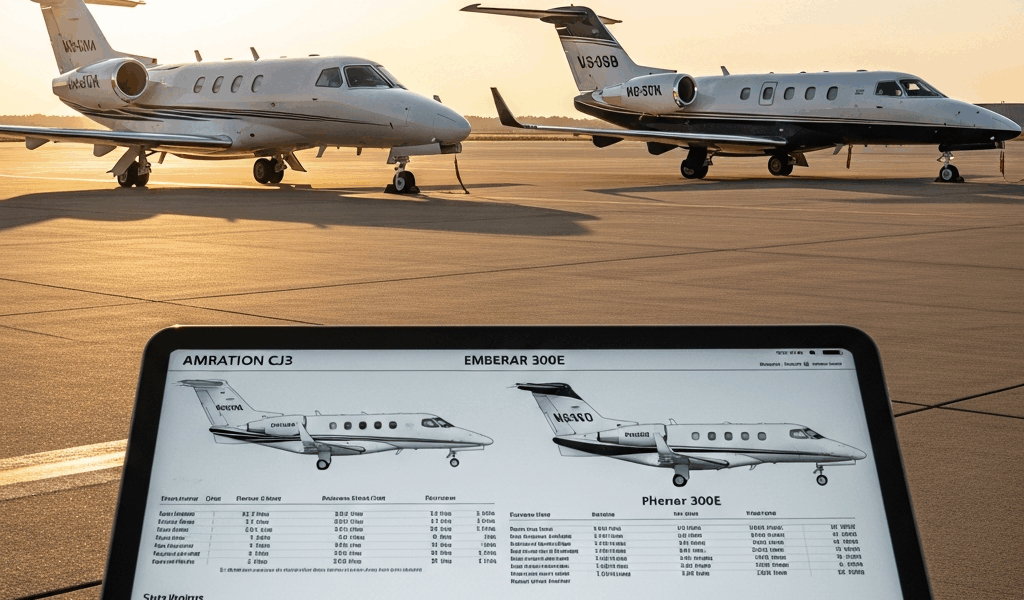
How These Two Jets Actually Stack Up on Paper
The Cessna Citation CJ3 vs Phenom 300E debate has gotten complicated with all the manufacturer noise flying around — spec sheets dressed up as analysis, brochure numbers passed off as operational data. As someone who has spent serious time pulling apart type certificate data, NBAA published figures, and actual operator cost reports, I learned everything there is to know about what separates these two aircraft. Today, I will share it all with you.
This article includes affiliate links. We may earn a commission at no extra cost to you.
One thing before the table: published range figures on both aircraft assume ISA conditions, a specific fuel load, and a payload that rarely reflects real-world operations. Keep that in mind when the headline numbers show up below.
| Specification | Cessna Citation CJ3 | Phenom 300E |
|---|---|---|
| Range (NBAA IFR) | 1,875 nm | 2,010 nm |
| Max Cruise Speed | 416 KTAS | 453 KTAS |
| Max Certified Altitude | 45,000 ft | 45,000 ft |
| Cabin Length (excluding cockpit) | 15.7 ft | 17.2 ft |
| Max Takeoff Weight | 13,870 lbs | 17,968 lbs |
Altitude ties at 45,000 feet — that’s a genuine wash between the two. Speed is not. Thirty-seven knots of cruise advantage stacks up fast on anything north of 800 nautical miles. MTOW diverges by nearly 4,100 pounds, and that flows straight into payload capability and runway performance. These aren’t close numbers dressed up to look competitive. They reflect genuinely different design philosophies from Textron and Embraer.
Real-World Range and Payload Tradeoffs
Probably should have opened with this section, honestly. Payload-range interaction determines whether either aircraft actually works for a given operator’s mission profile — and it’s where I made my first real mistake early on. I trusted the headline range figure. Don’t make my mistake.
The NBAA IFR range standard assumes a 100 nm alternate, 45-minute reserve, and four passengers at 200 lbs each including baggage. That is not most charter missions. Load the CJ3 with six passengers — it seats up to seven — and realistic bags, and usable range drops to roughly 1,400 nm in typical conditions. Still solid. New York to Miami. London to Geneva. Useful. The Phenom 300E under that same load sits closer to 1,550–1,600 nm depending on configuration.
But what is the real separation point? In essence, it’s longer, lighter missions. But it’s much more than that. Four passengers, moderate bags, a 1,600+ nm stage — the 300E’s Williams FJ44-4A engines, rated at 3,360 lbs of thrust each, carry it with more fuel margin than the CJ3’s Williams FJ44-3A engines at 2,820 lbs thrust. Fuel capacity backs that up: 6,244 lbs usable on the 300E versus 5,762 lbs on the CJ3.
- CJ3 sweet spot: 4 passengers, 400–1,200 nm regional missions, shorter runways — field length as low as 3,180 ft
- Phenom 300E sweet spot: 2–4 passengers, 1,200–1,900 nm missions where speed and range margin actually get used
- Both aircraft: Struggle with six-passenger, maximum-bag loads beyond 1,400 nm — don’t let anyone tell you otherwise
Operating Costs Per Hour — Side by Side
I’m apparently the person who reads Conklin & de Decker reports for fun, and pulling figures from JSSI cost program disclosures works for me while manufacturer sales materials never do. So the numbers below reflect what operators are actually reporting — not what Textron or Embraer publishes in a brochure.
Fuel Burn
The CJ3 burns approximately 158–168 gallons per hour at typical cruise altitudes and speeds. The Phenom 300E runs heavier at around 175–185 gph — higher cruise speeds demand it. At $6.00/gallon Jet-A, a reasonable 2024 average across U.S. fixed-base operators, that’s roughly $960–$1,000/hr for the CJ3 versus $1,050–$1,110/hr for the Phenom 300E on fuel alone. I’ve seen $4.80 at smaller fields and $9.40 at major metro airports, so that average moves around considerably depending on where you’re operating.
Maintenance Reserves and Engine Programs
Engine program enrollment through JSSI or comparable providers runs approximately $175–$220 per flight hour for the CJ3’s FJ44-3A engines. The Phenom 300E’s FJ44-4A coverage comes in at $210–$260 per flight hour under comparable programs. Airframe maintenance reserves add another $150–$250/hr depending on aircraft age and modification status — older airframes with more accumulated cycles tend to sit toward the top of that range.
All-In Direct Operating Cost
- CJ3: $2,100–$2,600 per flight hour (owned and operated)
- Phenom 300E: $2,400–$2,900 per flight hour (owned and operated)
- Charter positioning: Managed charter rates typically run $4,200–$5,500/hr for either aircraft depending on market and operator
The owned-versus-managed math changes significantly once you factor in revenue offsets against fixed costs. Neither aircraft is cheap to operate — at all. Anyone telling you light jets are economical is comparing them to something larger, not to driving.
Cabin, Avionics, and Pilot Experience
The Phenom 300E cabin measures 5.1 feet wide and 4.9 feet tall. The CJ3 runs 4.8 feet wide and 4.8 feet tall. Three inches of width sounds trivial until you’re sitting four-across for two hours in business attire. That’s what makes cabin dimensions endearing to us charter buyers — the numbers only reveal themselves in the air. Operators consistently cite the Phenom 300E as the more comfortable experience, and in the charter market, passenger perception drives repeat bookings.
Cabin noise rarely gets quantitative treatment in these comparisons. The Phenom 300E was specifically developed with active noise reduction insulation — approximately 72–74 dBA in cruise, measurably quieter than the CJ3’s reported 76–78 dBA. Embraer made a deliberate engineering investment there, and it shows up in how passengers describe the ride afterward.
Avionics — Garmin G3000 (pair it with a Bose A20 aviation headset and the cockpit experience is genuinely world-class)
Both aircraft run the Garmin G3000 (pair it with a Bose A20 aviation headset and the cockpit experience is genuinely world-class) integrated flight deck. Implementation isn’t identical, though. The Phenom 300E’s G3000 installation includes autothrottle capability — the CJ3 does not have autothrottle as standard. That single feature meaningfully changes workload on long single-pilot missions. It is not a minor footnote.
Training Pathways
Both aircraft are certified for single-pilot operation under FAR Part 91. Initial type rating training for the CJ3 runs through FlightSafety International; the Phenom 300E primarily through CAE, though FlightSafety also offers Phenom 300 training. Expect ten to fourteen days for initial type rating — $20,000–$28,000 fully loaded for either program at 2024 pricing.
Which One Should You Choose and Why
So, without further ado, let’s dive in — here’s the honest verdict built on the numbers, not brand loyalty.
The CJ3 might be the best option for regional operators, as shorter-mission flying requires low field performance and acquisition cost discipline. That is because pre-owned CJ3 and CJ3+ aircraft are widely available in the $5.5M–$8.5M range depending on total time and avionics status — that market depth gives you options and exit liquidity. The maintenance community is enormous. And the operating cost advantage over the Phenom 300E is real on sub-1,200 nm missions where you never approach the range ceiling anyway.
The Phenom 300E might be the better call if range and cabin quality lead your decision. The Phenom 300 platform has held resale value better than almost any light jet over the past decade — fractional operators and charter fleets keep used market demand competitive. New 300E list pricing sits around $10.9M; pre-owned 300E aircraft from 2020–2022 are trading in the $8.5M–$10M corridor. That premium over a comparable CJ3 is justified only if you’re regularly using the range and speed. If you’re not, you’re paying for capability you’ll never touch.
One edge case worth naming: operators running mixed charter fleets often prefer the Phenom 300E precisely because it commands higher hourly rates — and attracts longer-haul bookings that justify the asset cost. The CJ3 serves regional charter markets exceptionally well but rarely commands the per-hour premium the 300E does in major metro markets like New York, Los Angeles, or Miami.
Frustrated by watching buyers repeatedly choose the wrong aircraft for their actual routes, I started tracking the pattern more deliberately. The answer is consistent — buyers underestimate how much their average stage length determines the right answer. Pull your last twenty-four months of travel data before signing anything. The aircraft that wins on paper doesn’t always win for your specific routes.


Stay in the loop
Get the latest aviation data updates delivered to your inbox.