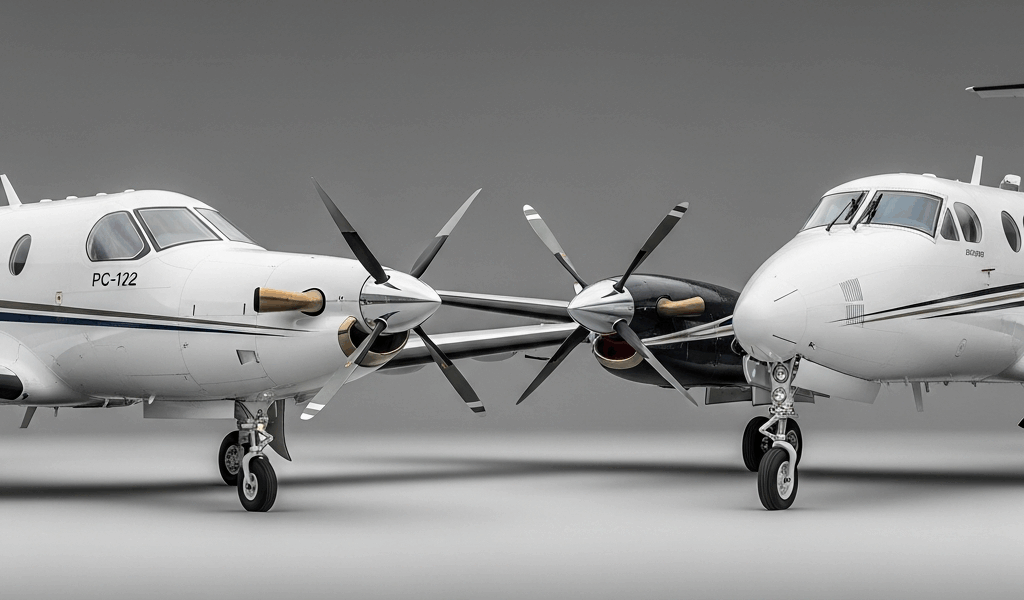
Pilatus PC-12 vs King Air 350 — Which Turboprop Should You Fly?
The PC-12 versus King Air 350 debate has gotten complicated with all the spec-sheet noise flying around. And I mean everything: the fuel stops, the weather diversions, the 2 a.m. post-flight debriefs where you’re second-guessing every call you made. These are not similar airplanes in different clothes. They’re genuinely different tools built around genuinely different philosophies.
Most comparisons online read like someone copy-pasted the type certificate data sheet and called it a day. Ceiling: this. Range: that. Nobody talks about what it actually feels like to plan a trip with eight executives aboard and a line of embedded convection sitting on your route. That’s the conversation worth having. So let’s have it.
This article includes affiliate links. We may earn a commission at no extra cost to you.
Single Engine vs Twin — The Real Tradeoff
Here’s where I’ll probably lose some people. The single-engine case for the PC-12 is stronger than most twin-engine advocates are willing to admit out loud.
But what is the actual tradeoff here? In essence, it’s redundancy versus simplicity. But it’s much more than that. The PC-12 runs a single Pratt & Whitney Canada PT6A-67P — 1,200 shaft horsepower, one fuel control, one set of reduction gears. The King Air 350 runs two PT6A-60A engines at 1,050 SHP each. The redundancy argument is real: one engine quits on the King Air, you fly home on the other. The PT6A on the PC-12 quits, you’re gliding and looking for a field.
I had that conversation with myself constantly during my first year in the PC-12. Then I actually read the accident data — sitting in a crew lounge in Salt Lake City one February night with nothing else to do, printing out NTSB reports on a shared office printer that kept jamming.
The PT6A family has one of the most reliable records in aviation. Pratt & Whitney Canada quotes mean time between unscheduled removals somewhere between 10,000 and 15,000 hours depending on the variant. PC-12 accidents, when you look at the actual NTSB data, are overwhelmingly weather and pilot-decision events — not powerplant failures. That’s a meaningful distinction. Don’t make my mistake of assuming otherwise for your first year.
That said, context matters. Flying over water with no divert options? Operating regularly into remote strips where a forced landing means mountains instead of fields? The King Air’s second engine isn’t just psychological comfort — it’s a legitimate safety margin. Twin-engine operations also unlock certain regulatory advantages under Part 135. Some charter operators and their insurance underwriters simply won’t approve single-engine IFR over certain terrain. Full stop. No negotiation.
Modern single-engine turboprop safety is genuinely excellent — that’s not spin. But the PC-12 is an extraordinary machine operating within real constraints. Know the constraints before you fall in love with the airplane.
Operating Economics
Probably should have opened with this section, honestly — because for most owner-operators and smaller charter outfits, economics drive the decision more than anything else does.
The PC-12 burns roughly 65 to 70 gallons of Jet-A per hour at cruise. At current FBO prices around $6.50 per gallon — and often higher at the smaller strips where the PC-12 excels — you’re looking at $425 to $455 in fuel per hour. All-in direct operating costs land between $750 and $900 per hour depending on utilization and base location. Charter operators commonly price the PC-12 around $800 per hour for retail clients, sometimes higher in premium markets like Aspen or Jackson Hole.
The King Air 350 burns roughly 90 to 100 gallons per hour across both engines at typical cruise settings. That’s $585 to $650 in fuel alone. Then you’re maintaining two engines, two propellers, two fuel controls, and all the associated systems duplication. All-in direct operating costs for the King Air 350 commonly run $1,200 to $1,500 per hour. Charter rates typically start around $1,400 per hour and climb from there.
The gap is significant — on 500 hours of annual utilization, the difference in direct operating costs between the two types can easily exceed $250,000 per year. That number buys real things. A second pilot. A hangar. Several years of that math and you’ve offset most of the acquisition price difference between a used PC-12 and a comparable King Air 350.
Maintenance and Insurance
My biggest lesson from switching between types was underestimating the maintenance cost difference. I assumed twin engines meant roughly double the engine maintenance. It’s actually closer to 2.3 to 2.5 times more — once you account for additional components, certification requirements, and the shop labor involved in keeping two powerplants airworthy. The King Air 350’s Beechcraft heritage means excellent parts availability and a mature maintenance ecosystem, which keeps costs from going completely sideways. But you’re still paying meaningfully more per hour, every hour.
Insurance differentials also matter more than most pilots expect before they actually price it out. Single-pilot PC-12 insurance for an experienced ATP with 500-plus PC-12 hours runs roughly $18,000 to $30,000 annually depending on hull value and operations. King Air 350 insurance — whether for approved single-pilot operations or two-pilot crews — carries a higher premium across the board. Budget at least 20 to 35 percent more on insurance for the King Air in comparable operations. It adds up faster than you’d think.
Acquisition Cost
A 2015 PC-12 NG in good shape trades between $3.5 million and $4.5 million — avionics package, interior condition, and total time all move the number. A comparable 2015 King Air 350 runs $4.5 million to $6 million. The gap narrows on older airframes and widens on newer ones. The PC-12 NGX, Pilatus’s current production version, lists new at approximately $5.5 million. A new King Air 350ER from Textron Aviation lists north of $9 million. Worth knowing before you fall down the listings rabbit hole at midnight.
Cabin and Mission Profile
The PC-12 cabin comparison surprises people who’ve never stepped inside one. It shouldn’t. That fuselage is genuinely wide — interior width runs approximately 59 inches at shoulder height — and standard corporate configurations seat nine passengers. The King Air 350 seats eight in a standard executive layout, up to eleven in high-density configurations, with an interior width of approximately 54 inches. On paper the PC-12 is slightly wider. In practice, the King Air 350 has a longer usable cabin — roughly 16.7 feet versus the PC-12’s 16.4 feet — which matters on six-hour missions when passengers start getting restless and moving around. Both airplanes feel legitimately comfortable compared to light jets. Neither is a wide-body. Set expectations accordingly.
Where the PC-12 creates a genuine competitive advantage — and That rear door measures approximately 53 by 52 inches. Standard freight, medical equipment, stretchers, skis, golf bags, oversized gear that won’t fit through standard airstair doors on the King Air — it all loads through the back. For medevac operators, cargo missions, or adventure travel clients hauling expedition equipment, this is not a minor feature. It fundamentally changes what the airplane can do on a given day.
Service Ceiling and High-Altitude Performance
Frustrated by being stuck below weather on routes where the King Air was comfortably in the clear, I started planning PC-12 trips differently — which is honestly the right adaptation, but it costs you time. The King Air 350’s service ceiling is 35,000 feet. The PC-12 NG tops out at 30,000 feet. On long routes threading weather systems, that 5,000-foot advantage can mean flying over embedded convection instead of through it. I’ve been below weather in the PC-12 on routes I’d rather not describe in detail. The gap is real and it matters on certain routes — particularly through the central US during convective season.
Range is comparable. The PC-12 NG delivers approximately 1,560 nautical miles with standard reserves. The King Air 350 does roughly 1,800 nautical miles. For transcontinental US operations, both types require fuel stops — plan accordingly. For the Northeast-to-Southeast corridor, both can go nonstop in most conditions. The range difference becomes operationally relevant mainly on specific international or over-water routes.
The Verdict
Drawn into this comparison more times than I can count — by clients, fellow pilots, and people staring at aircraft listings trying to figure out where to put several million dollars — I’ve landed on a framework that actually holds up in practice rather than just on spec sheets.
The PC-12 might be the best option if your mission requires low operating costs and genuine utility flexibility — that is because the economics are compelling, the Honeywell Primus Apex avionics suite on the NG and NGX is genuinely excellent, and the cargo door opens up mission profiles the King Air simply can’t match. If you’re an owner-pilot flying yourself and small groups on missions under 1,000 nautical miles over landable terrain, fly the PC-12. Full stop. The single-engine safety record is defensible. Most PC-12 operators eventually stop losing sleep over the single-engine question and start worrying about the usual things: weather, fuel planning, schedule pressure from clients who booked too late.
The King Air 350 earns its premium if you’re running a Part 135 charter operation on longer routes, frequently flying over mountainous or over-water terrain, operating in weather environments where that higher ceiling provides real strategic advantage, and your passengers — or your insurance underwriter — expect a twin. The operating cost gap is real but it comes with real capabilities attached.
Don’t make my mistake of treating this as a question of which airplane is better. Neither is better. The PC-12 is a smarter tool for a specific set of missions. The King Air 350 is a smarter tool for a different set. This new clarity took off several years into my flying career and eventually evolved into the framework operators I respect most know and apply today — map your actual mission profile honestly, not the aspirational version, and the answer usually becomes obvious before you’ve finished the analysis.
While you won’t need to fly both types for years to make a good decision, you will need a handful of honest conversations with yourself about what you’re actually flying — routes, terrain, passenger expectations, budget. First, you should price out a full year of operations in both types — at least if you’re making a purchase decision rather than just a theoretical one. The pilots who get into trouble with this choice are the ones who buy the airplane for the mission they wish they were flying instead of the mission they’re actually flying.
Know your mission. Pick your airplane accordingly.


Stay in the loop
Get the latest aviation data updates delivered to your inbox.