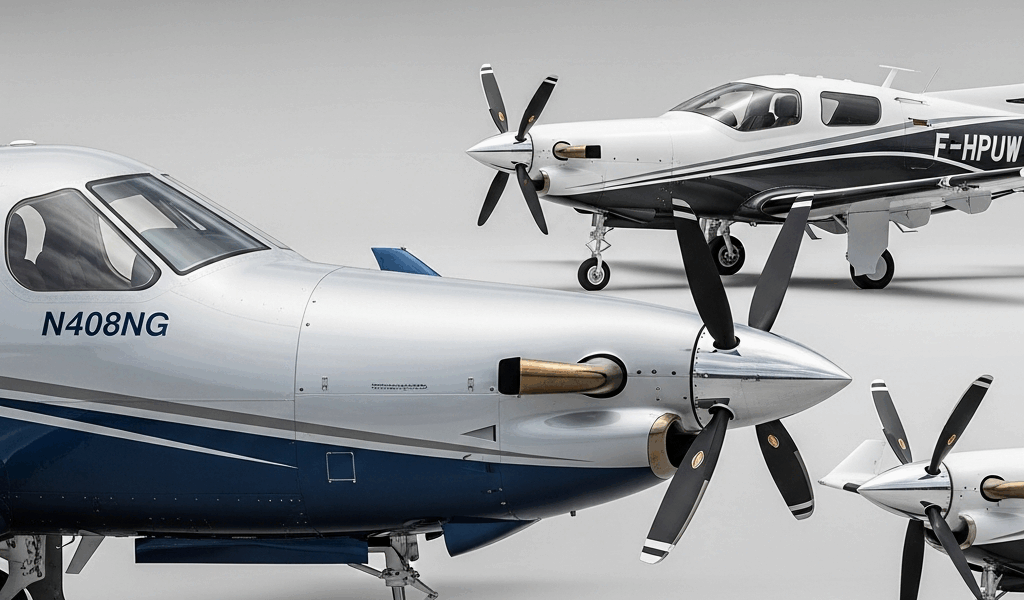
Pilatus PC-12 vs TBM 960 — Which Single-Engine Turboprop Wins?
The Pilatus PC-12 vs TBM 960 debate has gotten complicated with all the spec-sheet noise flying around. As someone who ferried charter passengers in a PC-12 NG and logged real hours in a TBM 900 series before the 960 even existed, I learned everything there is to know about what separates these two machines. I have opinions. Strong ones. And I’ll back them up with numbers — because at this price bracket, feelings are expensive.
Here’s the short version: these are not the same airplane trying to do the same thing. The PC-12 is a Swiss utility knife the size of a small regional airliner. The TBM 960 is a pressurized performance machine that wants to embarrass light jets. Choosing between them isn’t some abstract exercise. It’s about what you actually need the airplane to do on a Tuesday in November flying into a short strip in Montana.
Let’s get into it properly.
This article includes affiliate links. We may earn a commission at no extra cost to you.
PC-12 vs TBM 960 — Two Philosophies
Pilatus built the PC-12 in Stans, Switzerland — first flight in 1991. The design brief was essentially: build a single-engine turboprop that can do everything. Medical evacuation. Cargo. Parachute operations. Corporate shuttle. Bush flying in Africa. Genuinely multi-role, not just theoretically capable. That philosophy shaped every decision — the enormous rear cargo door at roughly 53 by 51 inches, the flat floor, the tall cabin, the PT6A-67P engine rated at 1,200 shaft horsepower.
TBM is a joint venture between Daher in France and Socata. The lineage runs back to the TBM 700, which entered service in 1990. The entire TBM line has always chased one metric above everything else — speed. The TBM 960, which entered service in 2022, uses a Pratt & Whitney Canada PT6E-66XT producing 1,825 shaft horsepower. That’s a meaningfully different powerplant. It shows in the numbers. The TBM 960 also introduced what Daher calls the EPAS system — an Electronic Propeller and engine control setup with auto-throttle. First single-engine turboprop to get that certified. It genuinely changes workload in cruise.
Probably should have opened with this section, honestly — because these philosophical differences explain every spec comparison that follows. You can’t understand why the PC-12 is slower without understanding that Pilatus never optimized for cruise speed. They optimized for versatility and useful load. And you can’t understand the TBM 960’s comparatively modest cabin without understanding that Daher squeezed every available gram into the airframe to go faster and higher.
Powerplant — Different Engines, Different Goals
Both aircraft use variants of the Pratt & Whitney Canada PT6 family. But what is the difference between them? In essence, it’s a gap in power output and automation philosophy. But it’s much more than that. The PC-12 runs the PT6A-67P. The TBM 960 runs the PT6E-66XT — more power, dual-channel FADEC, paired with that auto-throttle system. Engine management in the TBM 960 is closer to a jet than a conventional turboprop. Set a target speed, and the airplane handles the rest.
The PC-12’s engine is not FADEC-equipped. More conventional power management. For some operators — especially those flying into challenging environments where tactile engine feel matters — that’s a feature, not a limitation. I’ve talked to bush pilots in East Africa who actively prefer the analog feedback. For a high-utilization owner-pilot operation in the U.S. or Europe, though, the TBM’s automation cuts fatigue on long days.
Certification and Operational Flexibility
The PC-12 holds a transport category certification in most markets — matters enormously for commercial operations. The TBM 960 is certified under normal category rules. That distinction affects what kind of commercial work each aircraft can legally do across various jurisdictions. Charter operators often seek the PC-12 specifically for this reason. The TBM is overwhelmingly an owner-flown airplane. The PC-12 is both — and that’s what makes it endearing to us utility-minded operators.
Speed, Range, and Payload Compared
Raw numbers first. Context after.
- TBM 960 cruise speed: 330 knots true airspeed at FL280
- PC-12 NGX cruise speed: 290 knots true airspeed at FL300
- TBM 960 range (IFR reserves): approximately 1,730 nautical miles
- PC-12 NGX range (IFR reserves): approximately 1,803 nautical miles
- TBM 960 max payload: approximately 1,653 lbs
- PC-12 NGX useful load: approximately 3,593 lbs
- TBM 960 service ceiling: 31,000 feet
- PC-12 NGX service ceiling: 30,000 feet
The TBM 960 is faster. About 40 knots. On a 500-mile trip, that’s 15 to 20 minutes. On a 1,500-mile trip, closer to 45 minutes. Whether that matters depends entirely on your schedule — and how many people you’re carrying.
The Payload Story — Where the PC-12 Dominates
Here’s where the comparison gets genuinely interesting. The PC-12 NGX useful load of around 3,593 lbs is a completely different category. Full fuel in the PC-12 runs about 2,500 lbs — leaving roughly 1,000 lbs of payload at max range. Fill nine seats with average-weight adults and bags and you’re looking at 1,800 to 2,200 lbs of payload. The PC-12 handles that configuration with meaningful range remaining.
The TBM 960 seats six in standard club configuration. Maximum. Try loading six adults with luggage and you’re making hard choices about fuel. The numbers get tight fast.
Don’t make my mistake. Flying with four large adults and their bags, I ran the TBM 900 weight and balance and found myself at or over gross with full fuel. We offloaded luggage and planned a fuel stop — with a rental car waiting on the other end. The PC-12 would have handled that exact load without blinking.
Short Field Performance — A Tie, But Different
Both aircraft have excellent short-field performance by general aviation standards. The PC-12 is famous for it — Pilatus quotes a takeoff distance over a 50-foot obstacle of around 2,165 feet in standard conditions. The TBM 960 needs approximately 2,480 feet over 50 feet in similar conditions. The PC-12 is genuinely better in short fields. Not just a brochure claim — the reputation is earned.
Landing performance tells a similar story. The PC-12 gets in shorter. Not dramatically, but meaningfully — especially if you’re regularly operating into strips under 3,000 feet.
Range at Different Load Conditions
At light loads — two passengers, minimal bags — the TBM 960 and PC-12 trade range leads depending on altitude and winds. The TBM benefits more from higher altitudes. It gets there quickly and the engine is optimized for that environment. The PC-12 carrying heavier loads sees its range advantage grow, because the weight penalty hits the TBM disproportionately hard.
For transoceanic ferry flights or long over-water legs, the PC-12’s larger fuel capacity and load flexibility give it the edge. Several PC-12s have crossed the Atlantic. Possible in the TBM — but it requires more planning and additional fuel systems in some configurations.
Cabin and Comfort
Walk up to both airplanes on the ramp and the size difference is immediately obvious. The PC-12 is a large airplane. Interior width approximately 59 inches, stand-up cabin height of 49.2 inches. At six feet tall, I can stand nearly upright in the PC-12. I cannot do that in the TBM. Not even close.
The TBM 960 cabin runs 56 inches wide at its widest — about 48 inches tall at center. On paper, not dramatically different. But the shape of the fuselage and the way the walls curve make the PC-12 feel significantly more spacious. Four hours in each airplane tells you everything the specifications don’t.
The TBM Experience — Speed With Trade-offs
The TBM 960 interior in executive configuration is genuinely beautiful. Daher partnered with design houses to create something jet-adjacent. Supportive seats, high-quality leather, excellent overall finish. At 330 knots and FL280, you arrive quickly — cabin altitude holds a comfortable 8,000 feet at max cruising altitude.
But. The TBM is louder than the PC-12 in most real-world reports. Not dangerously loud — cabin noise runs around 70 to 75 dB(A) in cruise, similar to a business jet. The PC-12 runs slightly higher in some configurations, though modern soundproofing packages through the Pilatus dealer network have narrowed that gap considerably in recent production years. Passengers who’ve flown both tend to call the TBM the “sportier” experience and the PC-12 the “more comfortable” one. That word choice is telling.
The PC-12 Cabin — Genuinely Different Class
Configured as a seven-seat executive transport, the PC-12 NGX offers cabin volume that simply doesn’t exist in the TBM. The aisle is walkable. You can stretch your legs. The rear cargo door means loading and unloading luggage is fast and dignified — not a contorted exercise in pulling bags over seat backs.
Pilatus offers the PC-12 in several standard configurations through their completion center: the Club-5 layout with club seating, the Commuter-9 with airline-style seating, and the Executive-6 with a larger forward galley and side-facing seat option. There’s also a dedicated air ambulance configuration used by REGA in Switzerland and operators worldwide. The TBM offers nothing comparable in terms of configuration flexibility.
Pressurization in both aircraft is adequate for comfortable travel. The PC-12 maintains 8,000-foot cabin altitude at FL300. The TBM 960 matches that performance at FL310. Neither system stands out as a meaningful differentiator — both keep passengers comfortable on long legs.
Avionics — The TBM 960 Leads on Technology
The TBM 960 ships standard with the Garmin G3000 integrated avionics suite — three large touchscreen displays, plus the EPASS auto-throttle system. Single-pilot IFR operations in IMC are less workload-intensive in the TBM 960 than in almost any other single-engine turboprop currently in production. That’s not marketing language. That’s just accurate.
The PC-12 NGX runs the Honeywell Primus Apex avionics system with Autoflight included. Excellent suite. Not quite as visually impressive as Garmin’s G3000 — and some pilots find the Honeywell interface less intuitive. That said, the PC-12 avionics are comprehensive, capable, and fully certified for single-pilot IFR. At this point it’s preference more than capability separating them.
Which One Is the Better Buy
New acquisition prices as of 2024 sit roughly at $4.7 million USD for a TBM 960 in base configuration and approximately $5.4 million USD for a new PC-12 NGX in standard configuration. Both manufacturers build to order with significant customization — these are ballpark figures reflecting real-world transactions, not sticker optimism.
Operating Costs — Per Hour, Honestly
Direct operating costs are close but favor the TBM in some analyses.
- TBM 960 direct operating cost: approximately $650–$750 per hour, depending on fuel price and maintenance reserve assumptions
- PC-12 NGX direct operating cost: approximately $700–$850 per hour in similar conditions
The PC-12 burns more fuel — around 65 to 70 gallons per hour in cruise versus the TBM 960’s 55 to 62 gallons per hour. At Jet-A prices hovering around $5.50 to $6.50 per gallon depending on location, that difference adds up. Roughly $12,000 to $18,000 per year in fuel costs alone separates them at typical owner usage levels — 300 to 400 annual flight hours.
Maintenance costs run closer to parity. Both aircraft have PT6 engines with strong worldwide support networks. Pratt & Whitney Canada’s Eagle Service Plan covers both engines — the TBM 960 ESP Gold contract runs approximately $110 per hour, and the PC-12’s PT6A-67P ESP program runs in a similar range. Both aircraft have strong resale markets, though the PC-12 has historically held value well given its wide operator base spanning government, humanitarian, and charter sectors globally.
Resale Value — PC-12 Has the Edge
The used PC-12 market is deep and liquid. PC-12s operate on every inhabited continent — government agencies, NGOs like the Flying Doctors, charter operators, and private owners all competing for used airframes. That demand floor keeps values stable. A ten-year-old PC-12 retains value in a way that compares favorably with almost any aircraft in the category.
The TBM market is also strong, but slightly thinner. The buyer pool concentrates in the owner-flown, high-net-worth individual segment — narrower by definition. The TBM 960 is new enough that its long-term residual curve isn’t fully established, but early data from TBM 930 and 940 transactions suggests healthy but slightly lower retention compared to PC-12 equivalents of similar age.
Clear Verdict by Buyer Type
After a dozen conversations with both PC-12 and TBM owners over the years, a pattern has emerged in who ends up genuinely happy with each choice.
Buy the TBM 960 if:
- You fly solo or with one to three passengers regularly
- Speed matters more than cabin volume on your typical mission
- You want the most advanced avionics and automation in a single-engine turboprop
- You fly primarily IFR at altitude over established airways without needing short-field access regularly
- Your typical mission runs under 1,000 nautical miles with light loads
Buy the PC-12 NGX if:
- You regularly carry four or more passengers
- Payload flexibility is a genuine operational requirement
- You operate into shorter or more demanding strips with regularity


Stay in the loop
Get the latest aviation data updates delivered to your inbox.