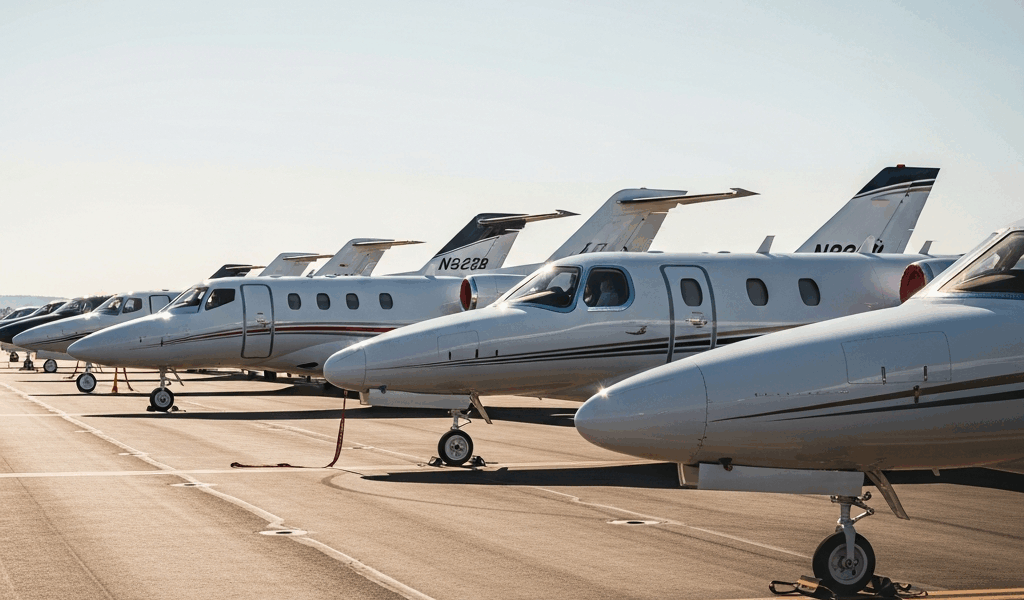
The single-pilot jet market has more capable aircraft in 2026 than at any point in aviation history. Five years ago, the choice was essentially the Cirrus Vision Jet or a used Citation. Now there are factory-new options spanning $3 million to $11 million, with range capabilities from 900 to 2,000 nautical miles, and a new entrant — the HondaJet Echelon — promising transcontinental range in a single-pilot airframe for the first time.
This article includes affiliate links. We may earn a commission at no extra cost to you.
Here are the five jets that matter for owner-operators in 2026, ranked by how well they serve the most common single-pilot missions, with the real operating costs that the brochures tend to leave out.
Cirrus Vision Jet G2+ — Safest Entry Point
Price: approximately $3.2 million new. Direct operating cost: $700-$1,200 per flight hour. All-in cost at 450 annual hours: roughly $2,300 per hour.
The Vision Jet has been the world’s best-selling business jet every year since 2018, and the reason is not raw performance — it is the complete ownership experience. The G2+ delivers 345 knots true airspeed, a service ceiling of FL310, and approximately 1,200 nautical miles of range at economy cruise. Those numbers place it at the bottom of the jet category by performance. They place it at the top by accessibility.
CAPS — the Cirrus Airframe Parachute System — is the headline differentiator. No other jet offers whole-aircraft ballistic recovery. For a pilot stepping up from a Cirrus SR22 or similar high-performance piston, CAPS provides a safety margin during the transition to jet operations that is impossible to replicate with training alone. The system has saved lives in piston Cirrus aircraft multiple times. In the jet, it covers scenarios from engine failure on departure to pilot incapacitation.
Cirrus also runs the most structured jet transition training program in the segment. The factory-backed program takes piston pilots through a multi-week course specifically designed for owner-operators, not career airline pilots. Combined with a global service center network and strong resale values backed by active production, the Vision Jet is the lowest-risk entry into jet ownership available today.
The tradeoff is clear: you give up speed and altitude. Pilots who regularly need to top FL350 to get above weather or who fly 800+ mile legs where the 85-knot speed deficit compounds into meaningful time differences will feel the limitation.
HondaJet Elite S — Range and Efficiency Leader
Price: approximately $6.1 million. Direct operating cost: approximately $1,200-$1,500 per flight hour. Fuel burn: 148 gallons per hour at high cruise.
The HondaJet Elite S cruises at 422 knots true airspeed with a range of 1,547 nautical miles and a service ceiling of FL430. The over-the-wing engine mount design — Honda’s signature engineering decision — reduces cabin noise and vibration measurably compared to fuselage-mounted engines. The cabin is also taller than any competitor in the light jet category at 4 feet 10 inches, because the wing spar passes under the floor rather than through the cabin.
For the single-pilot owner who regularly flies 600-1,200 mile legs, the HondaJet hits a sweet spot between the Vision Jet’s simplicity and the Phenom 300E’s capability. It is fast enough to make meaningful time savings over VLJs, has enough range to cover most domestic missions without fuel stops, and operates at a cost point roughly half that of a midsize jet.
The bigger news for 2026 is the HondaJet Echelon, currently in development with flight testing expected this year. The Echelon promises a transcontinental range of 2,625 nautical miles — enough to fly coast to coast nonstop in the United States — in a single-pilot certified airframe. If Honda delivers on that specification, it will be the first light jet capable of replacing a midsize jet for transcontinental owner-operators. Price and operating costs have not been announced, but expect a significant premium over the Elite S.
Cessna Citation M2 Gen2 — The Step-Up Classic
Price: approximately $5.5 million. Direct operating cost: approximately $1,300-$1,600 per flight hour. Maximum cruise: 404 knots true airspeed. Range: 1,300 nautical miles.
The Citation M2 Gen2 carries the weight of the most trusted name in owner-flown jets. Cessna has been building single-pilot Citations since the original Citation I in 1971 — over 50 years of refinement in what it means to make a jet accessible to pilots who fly themselves. The Garmin G3000 flight deck is shared across the Citation light jet line, which means training, proficiency, and muscle memory transfer if you eventually step up to a CJ3+ or CJ4.
For 2026, the bigger story in the Citation family is the CJ4 Gen3 entering service with Garmin’s Emergency Autoland system. Autoland detects pilot incapacitation and autonomously flies the aircraft to the nearest suitable airport, executes an approach, and lands. It is the most advanced safety system in single-pilot aviation after CAPS, and it addresses a different failure mode — not engine loss, but human performance failure at altitude.
The M2 Gen2 does not yet have Autoland, but the CJ4 Gen3’s introduction signals where the Citation line is headed. The M2’s strengths are proven: a 45,000-foot service ceiling, reliable Williams FJ44-1AP-21 engines, and the largest network of factory-authorized service centers in general aviation. If your primary concern is support infrastructure and long-term parts availability, no other manufacturer matches Textron Aviation’s footprint.
Embraer Phenom 300E — Performance King
Price: approximately $11 million. Direct operating cost: approximately $1,800-$2,200 per flight hour. Maximum cruise: 464 knots true airspeed. Range: 2,010 nautical miles.
The Phenom 300E is the fastest single-pilot certified jet in production. At 464 knots, it outruns every aircraft on this list by a comfortable margin. The 2,010-nautical-mile range covers virtually any domestic US mission nonstop and reaches most transatlantic positioning legs. The cabin is also the largest here — a flat-floor interior with a proper belted lavatory, not a curtained-off compromise.
This is the jet for the owner-operator who has graduated beyond the VLJ and light jet categories and wants no-compromise capability without stepping up to a midsize cabin that requires two crew. The Phenom 300 series has been the best-selling light jet in its category for over a decade, which speaks to the breadth of its appeal.
The price tag is the filter. At three times the cost of a Vision Jet, the Phenom 300E is not an entry-level purchase. It is the jet for someone who flies 300+ hours per year, needs to carry four to six passengers in genuine comfort over 1,000+ mile legs, and values arrival time enough to pay the premium. On a 1,200-mile trip, the Phenom saves roughly 45 minutes over a Vision Jet and 20 minutes over a HondaJet — meaningful when you are making that trip weekly.
Which Jet Fits Your Mission
First jet owner stepping up from pistons: Cirrus Vision Jet G2+. CAPS, factory training, active production, strongest transition support. The performance is adequate for 90% of owner-operator missions. Start here, upgrade later if you outgrow it.
Weekend trips and family travel under 1,000 nautical miles: HondaJet Elite S. Better speed and range than the Vision Jet, quietest cabin in the category, and the upcoming Echelon could make this a transcontinental airplane. Best balance of performance and operating cost.
Business travel with established flight department needs: Cessna Citation M2 Gen2. Proven platform, largest support network, and the CJ4 Gen3 with Autoland establishes where the family is headed. If you value institutional support over innovation, Citation is the answer.
No-compromise performance for high-utilization owners: Embraer Phenom 300E. Fastest, longest range, best cabin. Costs more to buy and operate, but if you are flying 300+ hours a year over long legs, the time savings and passenger comfort justify the premium. This is the jet you buy when you know exactly what you need.



Stay in the loop
Get the latest aviation data updates delivered to your inbox.