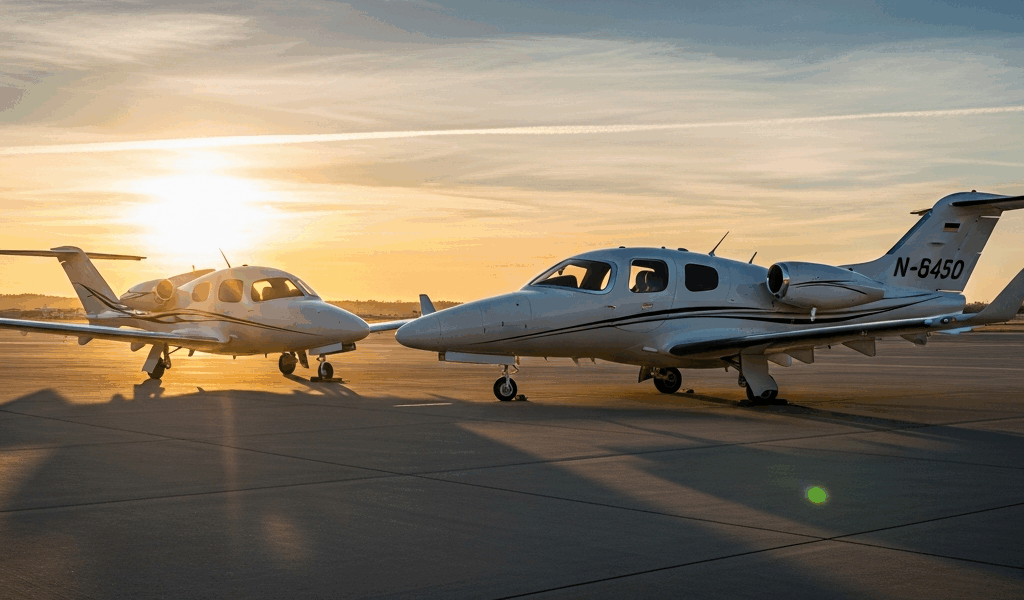
Two jets, both single-pilot certified, both priced around $3 million, both burning roughly 60 gallons per hour. The Cirrus Vision Jet SF50 and the Eclipse 550 are the closest competitors in the very light jet category, yet they are built on fundamentally different philosophies. One prioritizes safety systems and owner-operator simplicity. The other chases speed and altitude. Choosing between them comes down to what kind of pilot you are and what missions you actually fly.
Performance Head to Head
The Eclipse 550 is the faster airplane and it is not close. Maximum cruise speed hits 430 knots true airspeed compared to the Vision Jet’s 345 knots. The Eclipse also climbs higher — FL410 service ceiling versus FL310 for the Cirrus. For pilots who want to get above weather and cover ground quickly, the Eclipse has a measurable edge in raw performance numbers.
That speed advantage comes from twin Williams FJ33 engines producing a combined 1,800 pounds of thrust, compared to the Vision Jet’s single Williams FJ33-5A generating 1,846 pounds. The Eclipse distributes its thrust across two powerplants, which provides engine-out redundancy but adds complexity to training and maintenance. The Vision Jet compensates for its single engine with something no other jet offers: the Cirrus Airframe Parachute System (CAPS), a whole-aircraft ballistic recovery parachute that can bring the entire airframe down under canopy if the engine fails or the pilot becomes incapacitated.
CAPS has been deployed successfully in Cirrus piston aircraft dozens of times with survivors who would not have walked away from a conventional forced landing. Whether a parachute on a jet is worth the speed tradeoff depends on your risk calculus, but for the pilot transitioning from piston singles to their first jet, it represents a meaningful safety net during the steepest part of the learning curve.
Cabin and Comfort Compared
The Vision Jet cabin measures 5.1 feet high, 5.1 feet wide, and 11 feet long — slightly more spacious than the Eclipse 550 in every dimension. Cirrus configures it for five adults plus two optional child seats in the rear, while the Eclipse accommodates four passengers plus the pilot and a right-seat occupant.
Neither aircraft has a fully enclosed lavatory. The Vision Jet offers an emergency relief option behind a privacy curtain, while the Eclipse has a similar arrangement. On flights under two hours, this is rarely a deciding factor. On a three-hour leg with passengers, it becomes relevant.
The Vision Jet’s cabin is pressurized to a 8.0 psi differential, giving a cabin altitude of about 8,000 feet at FL310. The Eclipse 550 pressurizes to 8.6 psi, which at its higher service ceiling of FL410 still delivers a comfortable cabin altitude. Both keep passengers comfortable on typical missions, though the Eclipse’s ability to fly higher means it can often find smoother air above weather that the Vision Jet must navigate through or around.
What It Actually Costs to Own Each
A new Vision Jet G2+ lists at approximately $3.2 million. The Eclipse 550 is no longer in production — One Aviation, the Eclipse manufacturer, went through bankruptcy and ceased operations. Used Eclipse 550s trade in the $2.5 to $3.5 million range depending on total time, avionics condition, and maintenance status. That production gap matters enormously for long-term ownership.
Direct operating costs for the Vision Jet run $700 to $1,200 per flight hour depending on what you include. Fuel at $6-8 per gallon accounts for roughly $400-500 per hour at 60 gallons per hour cruise burn. Add hourly maintenance reserves, oil, and incidentals and you reach the $700 floor. Factor in insurance, hangar, annual inspection, and training recurrency and the all-in number climbs to approximately $2,300 per hour at 450 annual hours.
The Eclipse 550 has similar fuel burn — approximately 59 gallons per hour — so direct fuel costs are nearly identical. Annual operating budgets land around $520,000 at typical utilization. The wild card is parts availability and maintenance support. With the manufacturer out of business, Eclipse owners depend on third-party support organizations. Several reputable shops specialize in Eclipse maintenance, but parts lead times can be longer than for a Cirrus product backed by an active factory and global service center network.
Range and Mission Profile
The Vision Jet claims up to 1,400 miles at economy cruise speed with reduced payload. Practical range with a useful load — two or three adults and bags — is closer to 900-1,000 miles. The Eclipse 550 offers roughly 1,300 miles maximum range under similar conditions, with practical loaded range in the same 900-1,000 mile band.
For the most common VLJ mission — weekend trips of 400-600 nautical miles with two to four people — both aircraft handle it comfortably without fuel stops. Where they diverge is on longer legs. The Eclipse’s higher cruise altitude means it can often find favorable winds at FL390-FL410 that the Vision Jet cannot access at FL310. On a coast-to-coast trip with a fuel stop, the Eclipse might save 20-30 minutes on each leg simply by cruising 85 knots faster.
But coast-to-coast trips represent a small fraction of what VLJ owners actually fly. Flight tracking data from both fleets shows that the median trip length is under 500 nautical miles. For those missions, the speed difference translates to roughly 15-20 minutes — meaningful but not mission-critical.
Which One Should You Buy
The Vision Jet wins for the majority of buyers, and the reason is not performance — it is the ecosystem.
Cirrus is an active manufacturer with a global service center network, a structured transition training program for piston pilots stepping up to jets, and an owner community that functions as a genuine support network. The CAPS parachute provides a safety margin that matters most during the first 200 hours when a new jet pilot is building proficiency. The aircraft has been the world’s best-selling business jet every year since 2018, which means parts availability, resale value, and institutional knowledge are all strong.
The Eclipse 550 is the better airplane for an experienced jet pilot who prioritizes speed and altitude and is comfortable managing an aircraft from a defunct manufacturer. If you have 1,000+ hours of jet time, know a good Eclipse mechanic, and regularly fly 800+ mile legs where the speed advantage compounds, the Eclipse delivers more performance per dollar. The twin-engine configuration also provides redundancy that some pilots value over CAPS.
For first-time jet owners — which is the primary market for both aircraft — the Vision Jet is the clear recommendation. Active production, factory-backed support, CAPS, and the most refined owner-operator training program in the VLJ segment add up to a lower-risk entry into jet ownership. The Eclipse is a capable machine, but buying an orphaned aircraft as your first jet adds complexity to what is already a steep transition.


Stay in the loop
Get the latest aviation data updates delivered to your inbox.